Showing posts with label romance. Show all posts

Wednesday, October 28, 2015

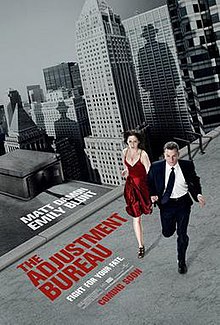
The Adjustment Bureau


The Adjustment Bureau Poster.jpg

Released:  March 4th, 2011
Rated:  PG-13
Distributor:  Universal Pictures
Starring:  Matt Damon, Emily Blunt, Anthony Mackie, John Slattery
Directed by:  George Nolfi
Written by:  George Nolfi
Personal Bias Alert:  likes the cast, likes old-school sci-fi

7.7 of 10


            Floating in on a puff of fresh air is The Adjustment Bureau, a sci-fi romance that is the polar opposite of the grim, desaturated landscapes that dominate modern fantasy.  It’s bright and bubbly, begging you to like it just as much as much as the main characters pine for each other’s attention.  There’s an underrated value to this sort of film, the kind that’s perfect in just about every situation for every sort of person.  Broad appeal is nothing to be scoffed at, not when it’s done as assuredly and as winningly as it is in this film.

            Undoubtedly, the MVPs of this endeavor are Matt Damon and Emily Blunt as the love-struck leads David and Elise.  They’re two honest-to-god movie stars, enjoyable to watch no matter what they’re doing, even if that’s just surviving alone in space or singing about a cow in the woods.  When put together their chemistry crackles, and watching them flirt is one of the more enjoyable things you can do with your free time.  Of course, the film puts obstacles in their way, in particular a shady group of men in fedoras who actively prevent them from being together, and their battle against these men forms the crux of the film.

            Many romance-against-impossible-odds stories falter when the going gets rough primarily because the relationship isn’t well established.  It’s either too rushed or not genuinely felt, and the audience is left wondering why the pair are fighting so hard to stay together instead of just moving on.  This is never an issue in The Adjustment Bureau, not because the antagonists are weak (the fedora-clad group have some mysterious connection to God), but because Damon and Blunt sell their romance so well.  And the writing backs them up, making Elise and David engaging, charming folk, which the actors pounce on and amp it up to 10.  How refreshing it is not to be taunted by a rabble-rousing antihero, but to be given characters you instantly like, leaving you to worry only about the machinations of the plot getting in their way.

            Adapted by writer/director George Nolfi from a Philip K. Dick short story, the plot throws enough thoughtful menace into the mix to give the fluffy romance some weight.  For all the pair have going for them, it seems plausible throughout that they may not end up together.  God is a pretty strong force, after all, even if he is only referred to in code.  Nolfi plays around with other concepts as well, namely the positives and negatives of free will, and although it’s not expounded upon, it provides enough layering to keep the film from being a lightweight.  Hardcore sci-fi fans may be disappointed by the film’s airiness, but it’s clear that Nolfi didn’t want the audience to get too bogged down by serious thought.

            Where Nolfi does take some chances, and where he might lose a few viewers, is his decision to present the film’s action with a punchy realness.  Nolfi is a screenwriting alum of the Bourne series, and the imprint of that can clearly be seen here.  When Damon’s David is under duress, the film becomes shakier and narrows in to the action.  Cars crunch and faces slam, the blows palpably resonating to the audience.  It would be understandable to find this choice incongruous with the rest of the film, but Nolfi makes it work, using it to emphasize the fedora men’s power and to up the ante against our protagonists.  This element is sparingly used, taking a backseat to the overpowering nature of the film’s romance, but it pops up enough to turn off those severely averse to action.  To everyone else, it will simply add a jolt of energy to the proceedings, making the romantic drive more immediate and in more real danger.

            It’s this tidy package of action, romance, and science fiction that gives The Adjustment Bureau its broad appeal, and the winning combination of Matt Damon and Emily Blunt put the film into rarified air.  This satisfying of a crowd-pleaser doesn’t come along too often, and it’d be a shame to overlook the charm it has to offer.

Other Notes:
Ø  My one solid negative on this film is the score.  It’s just too basic and too prominent.
Ø  I love this kind of old-school, on-the-nose sci-fi.
Ø  This goes down as one of the best examples of on-screen chemistry I’ve ever seen. 

Sunday, October 18, 2015

Crimson Peak


Crimson Peak theatrical poster.jpg

Released:  October 16th, 2015
Rated:  R
Distributor:  Universal Pictures
Starring:  Mia Wasikowska, Jessica Chastain, Tom Hiddleston, Charlie Hunnam
Directed by:  Guillermo del Toro
Written by:  Guillermo del Toro, Matthew Robbins
Personal Bias Alert:  loves Pan’s Labyrinth, mixed feelings about the cast

5.5 of 10


            With the revival of Hammer Films and the popularity of FX’s American Horror Story, the indulgently thrilling subgenre of gothic horror has been making a healthy comeback over the last few years.  It’s a perfect fit for director Guillermo del Toro, who makes lush films that unapologetically dive into whatever genre he’s selected.  Commitment has never been an issue for his films, and commitment is what you need to pull off the gothic high wire.  Unsure footing easily leads to camp or lethargy, and even an assured director like del Toro can stumble and make something subpar like, well, Crimson Peak.

            Named for a creepy mansion that oozes red goo and lets the snowfall in through its ruined roof, the film is about a young author, Edith (Mia Wasikowska), who falls for the dashing British man who owns the estate.  The house proves to have some less-than-hidden demons, and soon Edith finds herself warding off strange occurrences in every cranny of the house.

            Crimson Peak certainly wears the mantle of gothic horror with pride, seizing every opportunity to ratchet up the flair surrounding its simple story.  This is a gorgeous film that understands how delightful it is to see intricate tapestries and frilly dresses surrounding its monsters.  It’s got a rather traditional aesthetic, all greys and reds that, when paired with del Toro’s inventive vision, gives you some awe-inspiring moments of visual splendor.  Expect to hear its name called out many times come Oscar season and for it to take center stage in the program’s clip packages, because short snippets of this film is really the best way to take it in.

            The issues start piling up whenever Crimson Peak tries to tell its story, which despite a long script process that dates back to 2006, never feels more than half-baked.  Part of this is because of misleading expectations; the studio has marketed it as pure gothic horror, but long portions of it is really gothic romance.  That may seem like splitting hairs, but when someone goes in expecting Mary Shelley and gets a slightly bloody Jane Austin instead, they’ll almost certainly be disappointed.  The simple fact is that, despite a clear effort, Crimson Peak isn’t actually scary.  The pacing is all off, the ghosts are neither well designed nor clearly rendered, and the ending trips all over itself.  It’s possible that this stumbling be due to the film’s age.  Back in 2006, some of the twists del Toro takes us on may have seemed genuinely shocking, but now that we have American Horror Story and Penny Dreadful bringing bloody, shocking horror into our homes on a weekly basis, the story that Crimson Peak ends up telling seems decidedly quaint.

            The more detrimental error, though, is the film’s complete inability to form full, consistent characters.  It only needs to establish four people for the film to work:  Edith, her childhood beau Dr. Alan (Charlie Hunnam), Thomas, and Thomas’s sister Lucille (Jessica Chastain).  But del Toro and fellow writer Matthew Robbins fail to make any of them interesting throughout, most notably with Lucille and Alan, who are barely-drawn sketches that Hunnam and Chastain do their best to bring to life.  Thomas and Edith get a bit more attention, but the interesting traits they are given (Edith is a bit of a feminist and Thomas is an unacknowledged inventor) are picked up and tossed away on the fly.  As gothic stories tend to be slow movers, of which Crimson Peak is no exception, the lack of characters that you really care about cripples the film’s slow progress.

            Despite these disappointing setbacks, Crimson Peak will keep your attention throughout.  The cast does their best with what they’re given, and several of them are charming enough to watch even in their most flawed roles.  Sitting back and letting its visual charm wash over you is really the best way to take this film in, as you sure as hell aren’t going to get anything from its story.

Other Notes:
Ø  What a waste of Jessica Chastain.
Ø  Those ghosts really need to give more specific warnings.
Ø  Proposed drinking game:  drink whenever the shoulder ruffles on Chastain or Wasikowska’s dresses are larger than their heads.  You will get very drunk.

Sunday, April 12, 2015

The Longest Ride


The Longest Ride poster.png

Released:  April 10th, 2015
Rated:  PG-13
Distributor:  20th Century Fox
Starring:  Britt Robertson, Scott Eastwood, Jack Huston, Oona Chaplin, Alan Alda
Directed by:  George Tillman Jr.
Written by:  Craig Bolotin
Personal Bias Alert:  not a romance fan, immediately suspicious of anything Nicholas Sparks

4.5 of 10


            Can a name be a genre?  If any can, it’s Nicholas Sparks.  Even the casual moviegoer knows what they’re in for when that name flashes across the screen.  Star-crossed lovers, soft lighting, attractive leads.  They’re fairy-tale romances, the kind where love conquers cancer, dementia, and AIDS (okay, not the last one).  Emotions are encouraged, and there’s a box by the door where your brains should be left behind.  Needless to say, some people love his films and some hate them.  Some, like myself, grew up in a generation where there was always a girl squealing about how many times they’d watched A Walk to Remember or were dragged to The Notebook only to come out ragging about how unrealistic its portrait of dementia was.  That last one’s a true story from my life, so if you’re wondering where I come down on the Sparks spectrum, I firmly hate them.  But even the most begrudging viewer must admit that the Sparks films have hit on a pleasure center that exists in a fair number of people.  There is definitely a clamoring for these stories, and The Longest Ride is an inoffensive way to satisfy the need.

            In this, the tenth Sparks adaptation, the romantic leads are a bull rider and an art student, two people from different worlds whose lives cross for a brief, earth-shattering two months.  Yep, this film supposedly takes place over two months, a period of time that seems impossibly short given how many connections, dramatic turns, and feelings are crammed in.  In fact, there’s a B-plot involving an older man recounting his own marriage that’s nearly as time-consuming and jam-packed as the main storyline.  Yet for all this plot, none of it goes very deep.  Like most Sparks movies, the complications drift around behind the romance, only existing to complicate love instead of giving the characters any real sense of self.  But this is clearly something that the people want, so a reviewer can only shrug their shoulders, dock off a point, and move on, being careful not to dismiss the whole thing simply for being a lightweight.

            The main trio of the bull rider, art student, and dying man, are played by Scott Eastman, Britt Robertson, and Alan Alda, respectively.  Alda, obviously, needs no introductions or assurances that he can handle this material.  Eastman and Robertson were the wildcards going in, each with a decent amount of experience but no roles they can really hang their hat on.  Given their much larger roles on the horizon, The Longest Ride will likely be their forgotten introduction to wider audiences, but it’s still a charming turn for both of them.  They have solid chemistry, perform their modest roles with heartfelt familiarity, and succeed in making this innocuous love story fairly effective.  Compared to Alda’s remembered romance, theirs is downright grounded, and the ease with which Eastman and Robertson sell their romance is almost entirely to thank for it.

            The flashbacks with Alda, which takes place through letter reading (gag me), is the far more saccharine love story, and its combination of too-tall tales of war and dreadful dialogue sinks the whole section before it ever has a chance.  Alda and the actors who portray the young couple are fine.  It’s simply an overwrought story that feels rather unnecessary, and at nearly two and a half hours long, The Longest Ride suffers under the weight of this extra plot.

            And yet, these extra flourishes fit perfectly into the Sparks formula.  The problems keep coming for both couples until the release of tension becomes a necessity.  The emotions these moments engender are as cheap as the jump scares in a churned-out horror flick, but the formula is so smoothly presented here that it all slides by without much offense.  The only remarkable thing about The Longest Ride is its utter blandness, but at least its laziness won’t piss you off.

Other Notes:
Ø  The dialogue is so trite that there were numerous times my brain called word-for-word what the next line would be.  I refrained from saying them out loud only out of respect for my fellow moviegoers.
Ø  Speaking of my fellow moviegoers, I didn’t hear any crying, but people seemed pleased when they left.
Ø  You’d think the cowboy hat would make Eastman look more like his father, Clint, but it was a moment without the hat, when Scott scrunched his face into a scowl, that he most resembled his father.

Sunday, November 16, 2014

Beyond the Lights


BeyondtheLightsposter.jpg

Released:  November 14th, 2014
Rated:  PG-13
Studio:  Relativity Media
Starring:  Gugu Mbatha-Raw, Nate Parker, Minnie Driver
Directed by:  Gina Prince-Bythewood         
Written by:  Gina Prince-Bythewood
Personal Bias Alert:  dislikes romances, not familiar with either of the leads

4.5 of 10


            I’ve never been enamored by the music industry.  I’ve had long arguments about how oversexed or just plain weird imagery passes for entertainment, particularly in pop music, and often overshadows those who are writing honest and intelligent pieces.  I consider music the most passionate form of art, the one that most easily forms an emotionally connection to the audience.  The astounding gift of great musicians (some of whom do work in pop) are their ability to combine well-crafted melodies with vague yet emblematic lyrics that a wide swathe of people can personally connect to in a matter of minutes.  That’s why it frustrates me to see so much of the music industry focused on a performer writhing around on stage instead of the smart, sensitive things that can come from their brain.

            Beyond the Lights makes me thing that writer/director Gina Prince-Bythewood shares my point of view.  A major theme of the film is how adversely the hypersexual and inauthentic parts many young female pop artists play affects them personally.  It’s brought to the forefront from the beginning, when an emotionally inert emerging pop star named Noni (Gugu Mbatha-Raw) accepts her first Billboard Music Award in a bondage-esque, barely there outfit and promptly goes back to her hotel room to kill herself.  She is, of course, saved by a strapping and sensitive police officer (Nate Parker), who is rattled by her stoic demeanor immediately following the event.  The pair eventually falls in love, and Parker’s Kaz encourages Noni to make the sort of music she loves.

            At first, I was rather unimpressed by Mbatha-Raw and felt she was being outshined by the likable Parker, only to realize that she was masterfully portraying her character’s arc out of hopeless depression.  Early on, she actually feels like someone without the will to go on, someone stuck in the incessant quagmire of a deep depression that has deprived her of nearly all other emotions.  As Noni’s relationship with Kaz forces her to confront her problems and her long-buried ambitions, Mbatha-Raw gets to come out and play a full part.  A late scene allows her to show off how emotive she and good music can be in a powerful and effective culmination of both the character and the main theme’s arcs.

            The film features a scathing look at the music industry, pegging it as exploitative and insensitive to its young female stars.  Now I already thought that this sort of thing happened, but I was surprised to find that they were able to get across this message without exaggerating the film’s music videos, onstage performances, or photo shoots.  All look remarkable normal compared to their real-life counterparts, and that authenticity is perhaps the most damning pieces of evidence that the film presents.  Feel free to take a look for yourself; the video that was made for the film is on YouTube at https://www.youtube.com/watch?v=pP7gLPRDojg.

            For all these excellent pieces, Beyond the Lights staggers under a poorly constructed script.  While its themes and characters are strong, it tries to present them under the guise of a by-the-numbers romance, and the numbers couldn’t have been triter.  It was always painfully obvious what the next beat was going to be, sucking any suspense and narrative tension straight out of the film.  They try to pull some fast ones on you, but most are so poorly constructed, especially a late ‘who could be at the doorbell?’ moment, that they come across more as annoyances than surprises.

            The only mystery to the film is how it can simultaneously move through its beats so quickly while feeling so painfully long.  The big suicide attempt occurs in the first few scenes, and the romance starts jarringly fast.  After that, the film becomes mired in subplots that keep things moving but don’t always go anywhere.  With their outcomes predetermined, the sidetracking is both unnecessary and uninteresting, overly complicating a story that could have been effective if it had narrowed its scope a bit.

            There’s a lot to admire in Beyond the Lights, but it overstayed its welcome and had me tapping my feet in anticipation of leaving.  That’s disappointing, especially when you look back and realize how well it commented on the darker side of young pop stars’ lives.

Other Notes:
Ø  It’s really depressing that Prince-Bythewood had to fight to have this movie star two people of color.
Ø  The song that got me most excited was the cover of The xx’s Shelter.  That probably says a lot about my musical taste.
Ø  The cover story might have been a lie, but I’m willing to bet that alcohol, a balcony, and 5 inch stilettos really don’t mix well.