Showing posts with label Anthony Mackie. Show all posts

Wednesday, October 28, 2015

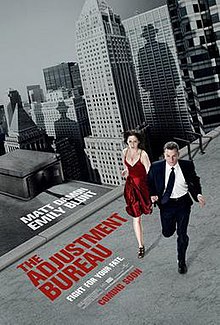
The Adjustment Bureau


The Adjustment Bureau Poster.jpg

Released:  March 4th, 2011
Rated:  PG-13
Distributor:  Universal Pictures
Starring:  Matt Damon, Emily Blunt, Anthony Mackie, John Slattery
Directed by:  George Nolfi
Written by:  George Nolfi
Personal Bias Alert:  likes the cast, likes old-school sci-fi

7.7 of 10


            Floating in on a puff of fresh air is The Adjustment Bureau, a sci-fi romance that is the polar opposite of the grim, desaturated landscapes that dominate modern fantasy.  It’s bright and bubbly, begging you to like it just as much as much as the main characters pine for each other’s attention.  There’s an underrated value to this sort of film, the kind that’s perfect in just about every situation for every sort of person.  Broad appeal is nothing to be scoffed at, not when it’s done as assuredly and as winningly as it is in this film.

            Undoubtedly, the MVPs of this endeavor are Matt Damon and Emily Blunt as the love-struck leads David and Elise.  They’re two honest-to-god movie stars, enjoyable to watch no matter what they’re doing, even if that’s just surviving alone in space or singing about a cow in the woods.  When put together their chemistry crackles, and watching them flirt is one of the more enjoyable things you can do with your free time.  Of course, the film puts obstacles in their way, in particular a shady group of men in fedoras who actively prevent them from being together, and their battle against these men forms the crux of the film.

            Many romance-against-impossible-odds stories falter when the going gets rough primarily because the relationship isn’t well established.  It’s either too rushed or not genuinely felt, and the audience is left wondering why the pair are fighting so hard to stay together instead of just moving on.  This is never an issue in The Adjustment Bureau, not because the antagonists are weak (the fedora-clad group have some mysterious connection to God), but because Damon and Blunt sell their romance so well.  And the writing backs them up, making Elise and David engaging, charming folk, which the actors pounce on and amp it up to 10.  How refreshing it is not to be taunted by a rabble-rousing antihero, but to be given characters you instantly like, leaving you to worry only about the machinations of the plot getting in their way.

            Adapted by writer/director George Nolfi from a Philip K. Dick short story, the plot throws enough thoughtful menace into the mix to give the fluffy romance some weight.  For all the pair have going for them, it seems plausible throughout that they may not end up together.  God is a pretty strong force, after all, even if he is only referred to in code.  Nolfi plays around with other concepts as well, namely the positives and negatives of free will, and although it’s not expounded upon, it provides enough layering to keep the film from being a lightweight.  Hardcore sci-fi fans may be disappointed by the film’s airiness, but it’s clear that Nolfi didn’t want the audience to get too bogged down by serious thought.

            Where Nolfi does take some chances, and where he might lose a few viewers, is his decision to present the film’s action with a punchy realness.  Nolfi is a screenwriting alum of the Bourne series, and the imprint of that can clearly be seen here.  When Damon’s David is under duress, the film becomes shakier and narrows in to the action.  Cars crunch and faces slam, the blows palpably resonating to the audience.  It would be understandable to find this choice incongruous with the rest of the film, but Nolfi makes it work, using it to emphasize the fedora men’s power and to up the ante against our protagonists.  This element is sparingly used, taking a backseat to the overpowering nature of the film’s romance, but it pops up enough to turn off those severely averse to action.  To everyone else, it will simply add a jolt of energy to the proceedings, making the romantic drive more immediate and in more real danger.

            It’s this tidy package of action, romance, and science fiction that gives The Adjustment Bureau its broad appeal, and the winning combination of Matt Damon and Emily Blunt put the film into rarified air.  This satisfying of a crowd-pleaser doesn’t come along too often, and it’d be a shame to overlook the charm it has to offer.

Other Notes:
Ø  My one solid negative on this film is the score.  It’s just too basic and too prominent.
Ø  I love this kind of old-school, on-the-nose sci-fi.
Ø  This goes down as one of the best examples of on-screen chemistry I’ve ever seen. 

Sunday, April 6, 2014

Captain America: The Winter Soldier (2014)

7 of 10

Personal Bias Alert:  This is my first Captain America movie, not a fan of blockbusters

            I can’t help but feel that my inexperience with the Marvel franchise has given me an unusual perspective on “Captain America:  The Winter Soldier.”  The lone film I’ve seen from the Marvel universe is “Iron Man.”  No Thor, Hulk, Avengers, or Captain America.  I also never read the comics, nor do I recall watching cartoons of any of these characters as a kid.  Here’s the rundown on my knowledge of Cap going into the film:  was a soldier in one of the world wars, the military made him into a super soldier, carries a shield, probably American.  This dearth of knowledge made me very concerned that I would get lost watching “The Winter Soldier,” but thanks to its clear storytelling my worries were unfounded.

            Captain America/Steve Rodgers (Chris Evans) starts this film at an oddly quiet time in his life.  Work has slowed, and he has enough time to start mulling over the direction his life has taken.  The people he grew up with are dead, and he’s having trouble fitting into the modern age.  Cap’s actually quite melancholy here.  He seems unable to let go of his past life, which gives newbies like me some time to get filled in on his story.  More importantly, he’s struggling with his growing disillusionment with SHIELD, which is exacerbated when Nick Furry (Samuel L. Jackson) shows him their latest creation.  It’s a trio of massive aircraft carriers designed to eliminate people who might be future threats.  Cap brings up some obvious moral problems (the people being killed haven’t actually done anything yet) and storms off, seemingly ready to quit.

            Of course, there’s no getting out that easy.  Furry is attacked by a mysterious hitman named the Winter Soldier.  Before dying, Furry entrusts Cap with some disturbing information:  SHIELD has been taken over from the inside.  This immediate threat kicks Cap out of his wallowing, and he teams up with Natasha Romanoff/Black Widow (Scarlett Johansson) and Sam Wilson/The Falcon (Anthony Mackie) to find out who compromised SHIELD.

            From here, the movie becomes a series of alternating spy and action scenes, building a plot elaborate enough to keep your attention but failing to become very interesting.  The spy sequences keep the information flowing, but they are too often exposition-filled rants instead of believable character conversations.  One scene even commits the cardinal sin of allowing someone to wax poetic about the bad guy’s entire plan to Cap and Natasha.  Seemingly knowing how bad the scene is, the writers throw in a line to try to explain his ramble, but it’s too little too late.

            The action sequences fall into repetition, and are further marred by their wanton destruction.  Cap seems to prefer hand-to-hand combat, which is fun until you see his shield boomerang back to him for the fifth time and you realize that none of these folks are on his level.  His nemesis, the Winter Soldier, has a mechanical arm strong enough to level the fight, but even those battles become underwhelming after multiple encounters.  Prior to the big finish, the large fight scenes take place mostly on the streets of Washington D.C.  Cars flip, run into each other, and get shot to pieces, regardless of whether the drivers are participants or bystanders.  I normally don’t think about this too much, but I was oddly bothered by it in this movie.  There are non-public places to fight.

            The plot machinations leave little time for anything else, so once they kick in after the attack on Furry, the previously interesting characters devolve into stock superhero characters.  Early on, Natasha and Sam have gentle conversations with the troubled Cap, encouraging him to engage with the world and find some happiness.  Both characters are filled out with their own problems, and Natasha has a running joke with Cap about finding him a girlfriend.  It’s telling that the joke isn’t mentioned throughout the middle portion of the film.  Natasha’s playful attitude waters down into cheesy one-liners, Sam becomes the capable sidekick, and Cap’s preoccupation with his past disappears and reappears when the plot requires it.  If the character’s had been maintained better, it might have hidden the fact that the film is nothing more than a series of plot points.

            It’s possible that my issues with the characters are influenced by the fact that I’m not as familiar with them as other moviegoers.  I’ve given the film the benefit of the doubt on that one, but the repetitive middle section and poor writing is inexcusable.  The films mostly concerned with its jumble of escalating set pieces, but it does try to add in some ideas about our society and its use of technology.  In the end, “Captain America:  The Winter Soldier” is only an average summer blockbuster, just released a little earlier than usual.

Other Notes (Ridiculous Action Sequence Version):
Ø  At one point, I thought I saw the Winter Soldier toss up a knife, punch Cap, catch the knife, and continue fighting.  It was moving too fast to tell for sure.  So why would you do that if the audience can barely see it?
Ø  None of the glass that Cap and the Winter Soldier stands on breaks while the ship crashes, except for that one piece that allows Cap to dramatically toss his shield away.
Ø  Sam outruns a crashing ship.  To make it worse, at one point he rolls over a desk and you can clearly see him stop to get up, but still the ship doesn’t catch up to him.
Ø  The Winter Soldier blocks gunfire with his mechanical arm.  An arm isn’t wide enough to do that.  Also, have they not heard of ricochet?  The way an arm curves, he would be likely to block the bullets right up into his face.

Other Notes (Normal Version):
Ø  Yes, I spotted Stan Lee.