Showing posts with label Dustin Hoffman. Show all posts

Wednesday, November 25, 2015

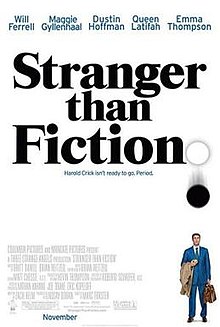
Stranger than Fiction


Stranger Than Fiction (2006 movie poster).jpg

Released:  November 10th, 2006
Rated:  PG-13
Distributor:  Columbia Pictures
Starring:  Will Ferrell, Maggie Gyllenhaal, Dustin Hoffman, Queen Latifah, Emma Thompson
Directed by:  Marc Forster
Written by:  Zach Helm
Personal Bias Alert:  likes the cast, likes novel-style narration

9.5 of 10


            Harold Crick is a man who counts his toothbrush strokes.  That says a lot about a person, making it exactly the kind of detail that a novelist would hone in on when describing their character.  So precise and so orderly a man would be perfect for high tragedy or comedy, an idea that Stranger than Fiction toys with for the better part of the movie only to flip on its head.  Most of the movie does this, setting up ideas with two possible outcomes only to take option C, a sweet and steady route that goes somewhere between what you thought was possible.

            In the film, Harold (Will Ferrell) wakes up to find his life being narrated.  Only he can hear the voice of Karen (Emma Thompson), who is in fact struggling to finish a book that ends in Harold’s death.  Her observations seem to kick in just when a novel would start, i.e. just when exciting things start to happen in Harold’s life.  It’s a tragedy that it took Harold this long to take an interest in what’s going on around him, but the layers that get peeled back reveal a witty, love-struck man (he’s fallen for an anarchist baker played by Maggie Gyllenhaal) that could easily morph the story into a comedy.  These are the two options laid out for Harold by literary professor Jules Hilbert (Dustin Hoffman), who Harold turns to to figure out which author is bringing about his imminent death.

            The high-concept pitch that a writer is writing a real man’s life is one that’s been used many times over, but what makes Zach Helm’s screenplay truly stand out is the tone he manages to hit.  It’s on the one hand extremely literary in its wording and themes, on the other hand sweet in its romance and characters, on one foot light and breezy in its movement, and on the other foot emotionally impactful in its big moments.  Note that I said tone, singular, because all of this magically feels like one complete feeling.  Of course, the only magic involved is Helm’s pitch-perfect screenplay, which on top of all this makes subtle nods to scientific and mathematic theories without being in-your-face about it.  It’s one of the most approachably smart screenplays you’ll come across, laying a groundwork that would’ve been heartbreaking to see flubbed.

            Luckily, director Marc Forster applies a perfect visual palette to Helm’s tale, picking up on every beat and adding a little flourish to bring it all home.  The film is bright and warm with oddball little things like equations and diagrams popping up as people go about their day.  It’s a subtle nod to the fantasy world the film exists it, one that all films exist in but few feel so comfortable wallowing in.  You are, it says to the audience, being told a story, and it invites you to snuggle in close and be swept along with the tale.

            As if these bountiful riches aren’t enough, the film is bursting with a superb cast, from reliable stalwarts like Thompson and Hoffman to side players like Queen Latifah and Tony Hale.  But this is Ferrell’s movie, and the role demands a gamut of skills audiences hadn’t seen from the comedian in 2006.  He had to be funny, yes, but in a quiet way; the exact opposite of how he was in Talladega Nights and Anchorman.  Mostly, though, Harold must be timid and lovable.  The film, like the book within it, is about figuring out how to find happiness in your life, and its lessons aren’t big or grand.  To make the whole thing work, Ferrell had to scale Harold’s actions down and trust that the larger emotions of the film’s moments would ring through.  Never is that more apparent than in a scene where he strums a guitar, singing in a wavering voice that explodes into a moment of pure ecstasy.  Gyllenhaal’s reaction to his quiet bravery is what makes it work, and this trust that Ferrell and Gyllenhaal show in each other makes for a lovely spark of romance.

            Stranger than Fiction radiates a tenderness that few films dare aspire to, which all but covers up its minor flaws.  The hairs on my neck stand up every time the film espouses its final verdict on life, rejuvenating me in bad times and solidifying me in good.  What more can you ask of your fiction?

Other Notes:
Ø  Don’t miss the fun fact that Emma Thompson plays a writer and is a writer in real life.  See her Best Adapted Screenplay Oscar for 1995’s Sense and Sensibility.
Ø  Admittedly, not everyone else is as high on this film as I am.  Rotten Tomatoes has it at 72%, Metacritic at 67%, and IMDB at 7.6 of 10.
Ø  “Anarchists have a group?”

Wednesday, November 5, 2014

Kramer vs. Kramer


Oscar posters 79.jpg

Released:  December 19th, 1979
Rated:  PG
Studio:  Columbia Pictures
Starring:  Dustin Hoffman, Meryl Streep, Jane Alexander, Justin Henry
Directed by:  Robert Benton              
Written by:  Robert Benton
Personal Bias Alert:  raised by a stay-at-home dad, finds emotional honesty riveting

8.5 of 10


            I’ve discussed before how difficult it is for ‘issue’ films to age well.  They often seem stuck in their time, commenting on aspects of society that no longer exist.  Watching it, you can appreciate the message its sending, but the shock and outrage is missing.  If the film isn’t about more than its central issue then it becomes doomed to fade away after society comes to its senses.  But if, like Kramer vs. Kramer, it takes a larger, honest look at the story at hand, then it can retain its emotional resonance throughout time.

            Starring Dustin Hoffman and Meryl Streep, Kramer vs. Kramer is about the ever-changing way we define family.  Specifically, this story takes on the traditional gender roles of parents after Streep’s Joanna divorces Hoffman’s Ted and leaves him with their young son.  Ted had been a workaholic, comfortable with leaving Joanna to take care of the household and the emotional needs of their child.  After her abrupt exit, Ted has to learn how to be more than just a breadwinner, or as Ted tells his son “I’ve got to bring home the bacon and cook it, too.”

            Now I grew up with a stay-at-home dad, so I’m used to seeing a man cook, clean, and shuttle the kids to their various activities.  This was still unusual at the time.  My dad has told me that there were no changing stations in men’s rooms when my brother and I were younger, so he had to ‘improvise.’  I never asked what exactly that meant, because I recognize that it’s probably one of those things best left unknown.  Anyway, what this means is that I’ve always known that fathers can be emotionally supportive and interested in their kids, and conversely that mothers can be intelligent and career-driven.  This is the essential message of Kramer vs. Kramer, and even if it’s outdated, it’s still a decent reminder as we battle more general gender stereotypes.

            Streep’s good in this, earning her first Oscar for the role, but she’s gone for long periods of time, leaving the audience predominately with Hoffman and Justin Henry, who played the couple’s son.  These two are extraordinary, nailing the many scenes between them and giving this film an honest core.  Hoffman, obviously, had been working for quite some time, but Henry was a first-timer, and a dreaded child actor at that.  To leave so much of the movie up to them, to leave each of their skills so bare to the camera, was a gutsy move by writer/director Robert Benton.  Luckily for him and all of us, both men stepped up to the plate.

            Because of these excellent performances and the excellent writing by Benton, Kramer vs. Kramer tackles not only the then-relevant issue of divorce, but also examines the way families and individuals respond to change.  Ted must learn how to balance work and life, and each must adjust their daily routines to their new post-Joanna world.  As with everything, this comes with some good and some bad, but what shines through is the father and son’s growing attachment to each other.  Being that they’re both men, they bond in some untraditional ways, and I love that the film uses little moments like how they share the bathroom in the morning to establish their bond.  It’s these more universal and timeless touches that allow the film to survive the years and will keep it relevant for generations to come.

            The other big thing that Kramer vs. Kramer has going for it is its brutal honesty.  Characters get hot under the collar and yell things they don’t mean, or things they do mean but are difficult to say.  A lot of time passes in this film, so you get to see the different emotional stages of the three family members and how they act in each one.  Sometimes they rise gloriously to the occasion, while other times they trip up and fall flat on their face.  Such is life, and these moments feel honest for each character.

            This truly is a wonderful movie, but it will lose steam for modern audiences when the divorce issue becomes more prevalent in its later portions.  Some of the statements that were grand and envelope-pushing at the time immediately dates it, placing it firmly in a world that some younger folks (including myself) weren’t alive for.  But there’s plenty of timeless stuff to overshadow these moments, and I walked away thinking about my own family, imperfect but loving, just like the Kramers.

            Other Notes:
Ø  That is a great scene between Ted and his neighbor in the park.
Ø  Joanna strikes some dramatic poses when she stalks people.
Ø  Is that a Tab sponsorship I see?
Ø  Ted’s pants were terrible.