Showing posts with label Anna Kendrick. Show all posts

Wednesday, December 2, 2015

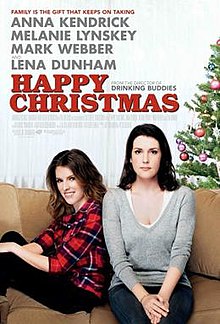
Happy Christmas


Happy Christmas poster.jpg

Released:  July 25th, 2014
Rated:  R
Distributor:  Magnolia Pictures
Starring:  Anna Kendrick, Melanie Lynskey, Lena Dunham, Joe Swanberg, Mark Webber
Directed by:  Joe Swanberg
Written by:  Joe Swanberg
Personal Bias Alert:  hit-and-miss on mumblecore, likes Anna Kendrick

7 of 10


            Mumblecore is quietly becoming one of the biggest filmmaking movements in America, but its founders reject that there’s any organization involved.  Instead, they surmise that the characteristic low-budget, organic feel is a natural response to mainstream cinema’s swelling budgets and rote stories.  Many of the founders are already making forays into bigger pictures, with Lynn Shelton, Mark Duplass, and Joe Swanberg attracting a variety of mainstream actors to their projects.  Despite this shift, Swanberg has chosen to keep his budgets low and with Happy Christmas reverts back to a micro-budget style (the film was made for a reported $70,000) after maxing out at $1 million for Drinking Buddies.  How this is possible with a cast that includes Anna Kendrick, Lena Dunham, and Melanie Lynskey is a mystery, but it’s one that you won’t bother to consider when watching the thoroughly enjoyable Happy Christmas.

            As a hallmark of the subgenre, the film is largely improvised, leaving the plot to be a loose, shaggy thing that doesn’t go anywhere drastic.  There’s a 30ish couple (Swanberg and Lynskey) with a young baby and a couch-surfing little sister (Kendrick) in need of a restart.  There’s hints early on of animosity that never quite blossoms.  Instead, the film circles around a story of familial love and responsibility that is worth the pain.  It’s a gentle conflict, but one that most people will recognize.  It’s refreshing, given the histrionics that come with most films about families, to find one that captures the calmness of day-to-day operations.  There’s annoyance and frustration, yes, but there’s also an affectionate history and a bond that runs too deep to break.

            Another easy cliché that the film manages to avoid is pigeonholing Kendrick’s Jenny as a good-for-nothing slacker.  She’s troubled and there’s hints that she’s rebounding from a bad relationship, but she’s also genuinely interested in her brother and sister-in-law’s life, not wanting to interrupt it for too long.  Kendrick plays her as someone smart enough to know that she’s intruding, and her attempts to make herself useful is what staves off animosity.  These efforts lead to a sweet relationship between Kendrick and Lynskey, one that feels genuine and is wonderfully navigated by the two actresses.  They make it feel as if they wander into the understatedly powerful moments that occur between these two characters, and given the genre, perhaps that’s what actually happened.

            However, the style sometimes gets in the way, as almost all of the moments when Happy Christmas stumbles can be traced back to its mumblecore tenets.  The aesthetic simply isn’t for everyone, and the low-fi camerawork, lighting, and sound design doesn’t make for an elegant film.  More coverage shots would give the film some energy, and the lackadaisical plot inevitably leads to some inconsequential scenes.  There’s a sense that Swanberg wasn’t out to make a perfect film but to capture some small moments that aren’t often observed.  This is something he does quite well, but it doesn’t make for a complete film.

            Despite its shortcomings, Happy Christmas is carried across the finish line on the backs of Kendrick and Lynskey.  Everything about the film quickly fades from your mind except a few raw and wholly recognizable moments between these two.  If that is truly all that Swanberg wanted to capture, then the mission was accomplished.

Other Notes
Ø  Here’s hoping that Lynskey gets more starring roles.
Ø  I’ve never taken to Lena Dunham, even here.
Ø  Fun fact:  the baby is played by Swanberg’s real-life daughter.

Sunday, December 28, 2014

Into the Woods


Into The Woods (film).jpg

Released:  December 25th, 2014
Rated:  PG
Studio:  Walt Disney Studios
Starring:  Meryl Streep, Emily Blunt, James Corden, Anna Kendrick, Chris Pine, Tracey Ullman, Christine Baranski, Johnny Depp
Directed by:  Rob Marshall
Written by:  James Lapine
Personal Bias Alert:  not familiar with the play, have seen twisted fairy tales many times

4.5 of 10


            Between the singing, the never-ending story, and the kid with the cockney accent I felt like I was having a flashback to last year’s Les Misérables.  The kid is in fact the same actor, Daniel Huttlestone, here playing Jack from Jack and the Beanstalk.  If you don’t already know, Into the Woods features a mashup of various Brothers Grimm fairy tale characters, something that was perhaps more inventive when the musical came out in 1986 but is now nothing to write home about.  Still, the movie does feature an impressive cast, most of whom we already know can sing.  Sondheim also has a certain clout, so I went in hoping this would be an enjoyable family film.

            Let’s get the obvious out of the way first:  all the actors pull off their parts.  There’s some variation as to how well they pull them off, but no one grinds things to a halt.  Emily Blunt and James Corden as the only original characters (a baker and his wife) are great together, a one-two punch of comedy, musical chops, and general affability that provides a solid anchor.  If the film had focused on this pair’s search for the four ingredients the witch needs to grant them a child, I would’ve been a happy camper.

            But alas, the film has some larger statements in mind, so we get meandering offshoots about Little Red Riding Hood (Lilla Crawford), Cinderella (Anna Kendrick), Rapunzel (Mackenzie Mauzy), and Jack.  Did I miss anyone?  I may have missed someone.  Anyway, there’s a lot of side characters, most of whose storylines are pretty basic but feature big musical numbers that many in my theater reacted to like they were showstoppers (The princes’ Agony earned particularly big applause).  I was less impressed than my fellow Christmas morning moviegoers, finding Into the Wood’s brand of fairy tale skewering quaintly old hat and being more than a little thrown off by Sondheim’s wordy lyrics.

            Now, admittedly, these are all inherited problems from the musical, but what I was particularly unimpressed by was the translation into film.  I feel like there was a great opportunity to open this thing up, to really explore the titular woods and have some fun with the more fantastical elements, but it’s all left fairly monochromatic.  The big set pieces seem to always be just off-frame, an element that’s necessary in a play but frustrating in a movie.  However, the most troubling symptom of this is the woods itself.  It lacks any sense of personality or menace.  It’s just a jumble of trees that everyone seems to be walking through or talking about all the time.  Why everyone’s so concerned about it I don’t know because nothing very bad seems to happen there, at least nothing that the woods should be get credit for.

            By the time the bad things do start happening to people, it’s pretty clear that most of it is the character’s own fault.  It’s generally attributable to some underlying fault in the fairy tale, a twisted take on something you’re supposed to find Charming (Prince Charming, get it?  Hooray puns.).  The problem is that most of the things Into the Woods points out is incredibly basic, lacking any real bite for an adult audience.  It’s my understanding that the film is a watered-down version of the musical, which leaves me wondering why they would tone it down so much.  Wouldn’t a PG-13 interpretation allow them to keep more of the material that made the musical a hit while still reaching a wide audience?

            Luckily, many of the one-liners still worked and had me belly-laughing from time to time.  I wasn’t blind to the sarcasm underlying all this, it just wasn’t very well sustained.  I had to sit through long, boring periods before it shone through in a wittily sardonic line or at least a pleasant scene between Blunt and Corden.  These bright spots just didn’t add up to a complete product and only served to make the whole thing seem even more dull and drawn-out than it really was.

            Other Notes:
Ø  There was about 20 minutes in the middle where I was totally into it.  For the rest of the time it barely held my attention.
Ø  See, prerecording the songs works just fine.
Ø  Was the Rapunzel/prince storyline really necessary?  I feel like that’s an easy thing to cut out.
Ø  Why can’t you just have a wolf?  Why do you need Johnny Depp dressed up as a wolf?  And of course it’s Johnny Depp dressed up as the wolf.

Wednesday, September 24, 2014

50/50

50 50 Poster.jpg
Released:  September 30th, 2011
Rated:  R
Studio:  Summit Entertainment
Starring:  Joseph Gordon-Levitt, Seth Rogen, Anna Kendrick, Bryce Dallas Howard, Anjelica Huston
Directed by:  Jonathan Levine
Written by:  Will Reiser
Personal Bias Alert:  dislikes manchild jokes, likes Joseph Gordon-Levitt

4.5 of 10


            What’s funny about cancer?  “First of all, it starts with that hard C sound, that K.  That is a comedy principle,” said Sarah Silverman in her Stand Up to Cancer video.  She goes on to tell a few more jokes while weaving in a serious message, mirroring in three minutes what it takes 50/50 100 minutes to do.  Now, I know that Silverman’s video and 50/50 are entirely different mediums of work, which partially explains the time difference, but it also highlights how much more a film is expected to do.  50/50 tries to do more, but too much of it feels false to get across any larger meaning.

            Much ado was made during the film’s release about the story being based on writer Will Reiser’s own cancer incident (he recovered before writing the script).  The story loosely follows Reiser and friend/co-star Seth Rogen’s experience, focusing on how the unexpected cancer diagnosis of 20-something Adam (Joseph Gordon-Levitt) effects his friends, family, and himself.  Perhaps this gave me some false expectations.  I was hoping for a funny, insightful film that felt close to reality, and what I got was a formulaic, manchild comedy with an affecting ending.  Needless to say, I was disappointed.

            My biggest problem with the film, which would have bothered me even without my incorrect expectations, was just how unrealistic the whole thing was.  And I don’t mean the cancer scare.  I know that 20-somethings get cancer.  It’s the insufferable tropes surrounding Adam’s predicament that annoyed the hell out of me.  Between the inattentive girlfriend, the doctor with horrible bedside manners, the overbearing mother, the manchild best friend, and the terrible therapist, I couldn’t find any genuine characters for Adam to interact with.  Every scene felt unnatural, and, well, written.  There are few things that annoy me more in a movie than being able to see the strings, and this film leaves them pretty bare.

            Moreover, this film just felt nasty to me.  It judges all its characters, hard, for the vast majority of its runtime.  The fact that they’re all so one-note, and that their notes are so negative, left me little room to care about them at all.  I mean, why should I care about a mother who overreacts to everything whenever she comes onscreen?  She’s not my mother, and Adam is perfectly fine with ignoring her, so I am too.  At least the best friend played by Rogan makes some effort, but he fails so miserably that I just wanted him to leave Adam alone.  Honestly, I didn’t even buy that those two would be friends, cancer or not.

            Then you have the technical aspects of the film, which too often stick out and add to the unreality of the whole thing.  I made two separate notes about how much I hated the music in this film, once after the cancer reveal and once in the scene where Adam’s high.  Although, the music wasn’t the only thing wrong with the overdone ‘Adam’s high’ scene.  Between the hackneyed cinematography, the ridiculous slow-motion chuckles, and that music, I thought I had stepped into a happy version of Reefer Madness.

            The only spark in the first 75 minutes of this film are the scenes between Adam and Katherine, the young therapist played by Anna Kendrick.  Gordon-Levitt and Kendrick are the only ones with enough screen time and talent to overcome their thin characters, and there’s moments when their interactions feel genuine.  Add in that these two are the only characters allowed to show a shred of decency before the ending, and it’s no wonder I didn’t care about the rest of the movie.

            And let’s talk about that ending.  There’s such a sharp tone change in the last 25 minutes that it felt like a different movie.  The raunchy comedy is abandoned in favor of the big, emotional ending, which is a bit easy and familiar given the setup, but Gordon-Levitt sells it so well that it’s hard not to be moved.  I actually enjoyed this part of the film, probably because the characters around Adam were suddenly allowed to act like actual human beings.  They were still flawed, but their efforts inexplicably start to amount to something.  It’s not at all consistent with the rest of the film, but I was so happy that it was finally working that I threw up my hands and went with it.  I just wish the rest of the film had actually set this ending up.

Other Notes:
Ø  What world does this film exist in?  No doctor would be that oblivious while revealing a cancer diagnosis, and no one would do what Rogan’s character does with that picture.
Ø  The crude humor felt out of place.
Ø  I liked Kendrick and Gordon-Levitt’s relationship, but I’m not sure about the ethics of it.  I mean, he was her patient.
Ø  Sarah Silverman’s Stand Up to Cancer video:  https://www.youtube.com/watch?v=SGtaV85AzWE