Showing posts with label underrated. Show all posts

Wednesday, October 28, 2015

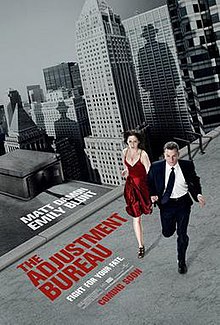
The Adjustment Bureau


The Adjustment Bureau Poster.jpg

Released:  March 4th, 2011
Rated:  PG-13
Distributor:  Universal Pictures
Starring:  Matt Damon, Emily Blunt, Anthony Mackie, John Slattery
Directed by:  George Nolfi
Written by:  George Nolfi
Personal Bias Alert:  likes the cast, likes old-school sci-fi

7.7 of 10


            Floating in on a puff of fresh air is The Adjustment Bureau, a sci-fi romance that is the polar opposite of the grim, desaturated landscapes that dominate modern fantasy.  It’s bright and bubbly, begging you to like it just as much as much as the main characters pine for each other’s attention.  There’s an underrated value to this sort of film, the kind that’s perfect in just about every situation for every sort of person.  Broad appeal is nothing to be scoffed at, not when it’s done as assuredly and as winningly as it is in this film.

            Undoubtedly, the MVPs of this endeavor are Matt Damon and Emily Blunt as the love-struck leads David and Elise.  They’re two honest-to-god movie stars, enjoyable to watch no matter what they’re doing, even if that’s just surviving alone in space or singing about a cow in the woods.  When put together their chemistry crackles, and watching them flirt is one of the more enjoyable things you can do with your free time.  Of course, the film puts obstacles in their way, in particular a shady group of men in fedoras who actively prevent them from being together, and their battle against these men forms the crux of the film.

            Many romance-against-impossible-odds stories falter when the going gets rough primarily because the relationship isn’t well established.  It’s either too rushed or not genuinely felt, and the audience is left wondering why the pair are fighting so hard to stay together instead of just moving on.  This is never an issue in The Adjustment Bureau, not because the antagonists are weak (the fedora-clad group have some mysterious connection to God), but because Damon and Blunt sell their romance so well.  And the writing backs them up, making Elise and David engaging, charming folk, which the actors pounce on and amp it up to 10.  How refreshing it is not to be taunted by a rabble-rousing antihero, but to be given characters you instantly like, leaving you to worry only about the machinations of the plot getting in their way.

            Adapted by writer/director George Nolfi from a Philip K. Dick short story, the plot throws enough thoughtful menace into the mix to give the fluffy romance some weight.  For all the pair have going for them, it seems plausible throughout that they may not end up together.  God is a pretty strong force, after all, even if he is only referred to in code.  Nolfi plays around with other concepts as well, namely the positives and negatives of free will, and although it’s not expounded upon, it provides enough layering to keep the film from being a lightweight.  Hardcore sci-fi fans may be disappointed by the film’s airiness, but it’s clear that Nolfi didn’t want the audience to get too bogged down by serious thought.

            Where Nolfi does take some chances, and where he might lose a few viewers, is his decision to present the film’s action with a punchy realness.  Nolfi is a screenwriting alum of the Bourne series, and the imprint of that can clearly be seen here.  When Damon’s David is under duress, the film becomes shakier and narrows in to the action.  Cars crunch and faces slam, the blows palpably resonating to the audience.  It would be understandable to find this choice incongruous with the rest of the film, but Nolfi makes it work, using it to emphasize the fedora men’s power and to up the ante against our protagonists.  This element is sparingly used, taking a backseat to the overpowering nature of the film’s romance, but it pops up enough to turn off those severely averse to action.  To everyone else, it will simply add a jolt of energy to the proceedings, making the romantic drive more immediate and in more real danger.

            It’s this tidy package of action, romance, and science fiction that gives The Adjustment Bureau its broad appeal, and the winning combination of Matt Damon and Emily Blunt put the film into rarified air.  This satisfying of a crowd-pleaser doesn’t come along too often, and it’d be a shame to overlook the charm it has to offer.

Other Notes:
Ø  My one solid negative on this film is the score.  It’s just too basic and too prominent.
Ø  I love this kind of old-school, on-the-nose sci-fi.
Ø  This goes down as one of the best examples of on-screen chemistry I’ve ever seen. 

Wednesday, October 21, 2015

The Innkeepers


The Innkeepers Poster.jpg

Released:  February 2nd, 2012
Rated:  R
Distributor:  Magnet Releasing
Starring:  Sara Paxton, Pat Healy, Kelly McGillis
Directed by:  Ti West
Written by:  Ti West
Personal Bias Alert:  likes moody horror, dislikes slacker characters

7.2 of 10


            A cursory glance at the horror landscape of today might leave you feeling that your only options are jump scares or gore, but that’s an incorrect limitation, as just below the Cineplex surface lies a thriving, diverse community of horror filmmakers that offer up every kind of scare under the sun.  After dredging it in the festival circuit, some of these filmmakers even get to peddle their wares to the masses, especially with the advent of streaming and VOD services.  One such director is Ti West, whose reputation has earned him segments in V/H/S and The ABCs of Death, and with The Innkeepers got to remind people of a more methodical kind of scare.

            Set in a real-life haunted hotel, most of the film is taken up by the lackadaisical investigation by the hotel’s staff of two, Claire (Sara Paxton) and Luke (Pat Healy).  The ghost at the Yankee Pedlar Inn is rather mundane:  a disappointed bride who killed herself on her wedding day.  Claire and Luke are interested, but they know they won’t find poltergeist-level events.  Luke just wants some decent EVP recordings to add to his rinky-dink website, and Claire is mostly game just because her friend is into it.  Therein lies the charm of this film; Claire and Luke are real friends, the kind that can while away hours in an empty hotel without being bored.  The fact that they’re doing it by investigating for a ghost just gives their well-worn games a little edge.

            Paxton and Healy both shine as too-old-to-be-doing-this slackers.  They know that they’re better than their current situation, but they don’t ask you to pity their underwhelming lives, either.  Healy plays Luke as someone not interested in getting out of his holding pattern, the kind of person you find managing a record store at a college campus just because he doesn’t want to leave.  Paxton is a bit younger and still believes that she can get out, but she’s not too concerned with figuring out where she wants to go.  For now, the pair are happy to pal around the hotel together, existing moment to moment while staving off boredom.  They’re not too unlike the resident ghost in that regard, and they’re invented entertainment proves to be more than endearing enough to sustain the early parts of this film.

            And their relationship has to carry you through, because West doesn’t give you many scares until late in the game.  While he sustains unease throughout by peppering in information about the ghost and setting up for later events, he clearly rejects the notion that audiences demand loud bangs or big jumps to keep them interested.  West instead relies on steadily building cues to keep our attention:  a locked basement, an odd old man, and some well-placed camera holds.  The lack of immediate payoff may frustrate some viewers, but those more in tune with old-school potboilers like Rosemary’s Baby will find a lot to like here. 

            For all that West gets right in the early going, the climax of the film is unavoidably a letdown.  There’s a nice ramp up of tension going into the big finale, and all the bread crumbs and character development seems to be leading to a satisfying ending.  Then it sputters, falling back on an ending that feels too much like a ploy to satisfy more mainstream viewers.  But the ending isn’t as big as it wants to be, and it goes too far out of its way in the effort to effectively wrap up all the small pieces.  It’s the kind of ending that satisfies no one, and it’s one that you tolerate simply because of your affection for the rest of the piece.

            The lack of effective scares may put The Innkeepers in an odd section of your movie library.  If those early parts work for you, it’ll prove to be a difficult film to watch only once.  Months after your first viewing, you’ll find yourself wanting to hang out with those two goofballs again, and you’ll re-watch the film just to get in a bit more quality time.  The fact that the pair are hunting ghosts will seem secondary in your lasting memory, but once the tension starts to build, you’ll remember that West’s low-key creepiness is just as addicting as your two fictional friends.

Other Notes:
Ø  There is one truly creepy shot from the finale that has stayed in my head for years.
Ø  I like this film’s humorous aversion to the horror movie sex cliché.
Ø  This is one of those films that I re-watch every six months or so.

Wednesday, October 14, 2015

Hanna


Hanna poster.jpg

Released:  April 8th, 2011
Rated:  PG-13
Distributor:  Focus Features
Starring:  Saoirse Ronan, Eric Bana, Cate Blanchett, Tom Hollander
Directed by:  Joe Wright
Written by:  Seth Lochhead, David Farr
Personal Bias Alert:  big Saoirse Ronan fan, likes electronic music

7.8 of 10


            The fairy tale element runs strong in this one.  You wouldn’t expect that if you saw any of Hanna’s print advertisements, and even the trailer quickly abandons the idea after a mystical opening.  It’s much easier to sell action, people understand that quickly, than to try and explain Hanna’s arthouse blend of coming-of-age drama and science fiction thrills.

            The screenplay, which appeared twice on the Black List (an annual list of the best unproduced screenplays in Hollywood), is the kind of dense, ambitious piece that gets kicked around for years before finding the right combination of star and director to get a green light.  Saoirse Ronan signing on as the waif-like assassin got the ball rolling, and her recommendation of Joe Wright, who previously directed her to an Oscar nomination in Atonement, got the film a healthy enough budget to see out its off-kilter vision. 

Wright is well-known for his prominent visual style, and he throws everything he can at the fantastical story of a young girl fighting to escape the clutches of the CIA.  He plays with lighting simply for the awe factor (see the incredible escape scene early in the film), and employs his trademark tracking shots on several occasions.  Wright isn’t an action movie director by trade, and it shows in how unconventionally he presents these sequences.  All of them work and are made more engrossing by their originality, eschewing the hip, quick-cutting jerkiness of most modern action in favor of meticulously choreographed, long fights.

The other odd element of these action scenes, namely that a young girl continuously bests grown men in hand-to-hand combat, is an overt nod to its fairy tale aspirations, but a closer look reveals that the action itself is only a B-plot to a more traditional fable.  Hanna is primarily a tale about growing into the adult world, where you make bonds and encounter complications that leave you bewildered and overwhelmed.  Ronan as the titular character is perfectly cast, with a body not yet sprung into a woman’s but with a face that can encapsulate the pain and the joy of being alive.  Her performances have long exceed her years, and this may be the best of her childhood work.

All these elements make for a rather fascinating film, but not an even one.  At times, the fairy tale elements overpowers everything else, and anyone craving a solid explanation for what exactly is going on will likely be disappointed.  Hanna is a piece that’s content with indulgence.  Some have labeled this as pretention, but don’t mistake Hanna’s grasping reach for a film that lacks goals.

Anyone who has seen Hanna is likely wondering when I will get to the film’s score, because it’s a prominent, make-or-break component.  Done by the electronic dance duo The Chemical Brothers, it blends the film’s elements into kookily loud beats, driving the action forward and carrying much of the weight when it comes to keeping the fairy tale-feel front and center.  The most prominent song, The Devil is in the Details, is even hummed by a character throughout, and this inescapability is what makes it so divisive.  It’s a bold score, to say the least, and some people will just never be into electronic beats.  No matter your personal taste, what’s undeniable is how complimentary it is to the film’s ambitions.

Hanna is a film that puts itself out there, and because of that has attracted some strong sentiments.  However, its supporters haven’t coalesced into a singular fandom, and without a strong cult status, it’s likely to become forgotten.

Other Notes:
Ø  I didn’t even mention how awesome Erica Bana, Cate Blanchett, and Tom Hollander are.
Ø  Speaking of Hollander, he has quite a knack for playing characters that subtly unsettle you.
Ø  “Did she turn out as you hoped?”  “Better.”

Wednesday, October 7, 2015

Notes on a Scandal


Notes on a Scandal.jpg

Released:  December 25th, 2006
Rated:  R
Distributor:  Fox Searchlight Pictures
Starring:  Judi Dench, Cate Blanchett, Bill Nighy
Directed by:  Richard Eyre
Written by:  Patrick Marber
Personal Bias Alert:  haven’t read the book, loves Philip Glass scores

8.5 of 10


            Behind the opening credits rolls a shot of notebooks, colorfully clustered and dated into little groups that tantalizingly hint at a hidden meaning.  The owner of these diaries is an older, single woman named Barbara (Judi Dench), who we see writing detailed, overblown entries in her current edition.  Her life is very simple:  teach, feed her cat, and wallow in the bitterness she feels towards a world that wants nothing to do with her.  Or so it would seem.  As we dive deeper into the woman’s mind, the organization of her diaries becomes clear, and we get a glimpse at her notes on one very particular scandal.

            This era in Barbara’s life is dominated by the presence of a new friend and colleague, Sheba (Cate Blanchett).  Sheba is the polar opposite of Barbara, a magnetic young butterfly lilting through the school’s insular world.  Everyone wants to be her friend, but Barbara manages to catch her eye, and soon the pair are sharing coffee and secrets.  Barbara proves much more invested in the relationship, and her conniving soon forces their lives to intertwine in a way that can only blow apart.

            The film is an unapologetically melodramatic stew of blistering observations and grand plotting, propelled with gusto by a prominent score from Philip Glass.  There’s a pulpy level that it can be enjoyed at, bounding along to the inevitable blowout that gloriously begins with a disheveled and brimming Blanchett sliding into frame.  But living alongside this, if you choose to acknowledge it, is an unwieldy world of bad guys and worse guys, one that never gives you a safe character to lean on but never lets you turn your back on any of them, either.  For all their faults, Barbara, Sheba, and their accompanying side players are given the dignity of some soft edges, some quiet moments that are utterly humane in their simplicity.  Their motivations are easily understood, even when it leads them to insanity.  It’s the kind of careful character building that elevates schlock into art and adds a layer of tragedy that lesser melodramatic fare lacks entirely.

            While we’re on the subject of elevation, let’s discuss the elephant in the room:  Dench and Blanchett.  One’s a legend and the other’s on her way, and the thought of the two being unleashed with each other, even back in 2006, was enough to salivate over.  And they are glorious together, grappling with their character’s big and small moments in a pair of pitch-perfect turns.  Their third wheel, Sheba’s husband played by Bill Nighy, proves to be right on par with the two leads, and the glorious riches that surround these main players are too numerous to list (Juno Temple as their daughter and Anne-Marie Duff in a bit part are just two).  Even if operatic melodrama simply isn’t to your taste, the power and skill of nearly every performance in Notes on a Scandal will be a satisfying reward for the time you invest.

            It would’ve been easy to get lost in the grandeur of this film, but director Richard Eyre and screenwriter Patrick Marber carefully infused the film’s world with such depth that there’s always something new to sink your teeth into.  Pay attention to the things littering Barbara and Sheba’s homes; an entire story can be found in the distinction between their worlds.  Eyre brings themes to life through the careful framing of Dench’s ever-present eyes, and Marber creates (or brilliantly lifts from the book) delightfully wicked turns of phrases that will stick in your mind for years to come.  Their balance of such fine details with the story’s larger elements is an impressive trick and one that is rarely pulled off so seamlessly.

            Perhaps these seemingly incongruous elements are to blame for this film’s current near-obscurity.  It was lauded by critics at the time of its release, but you now rarely hear it brought up, even when discussing Dench and Blanchett’s legacies.  Audiences didn’t shell out much money to see it upon its theatrical release, and there’s been no groundswell of support in the preceding years.  Whatever the reason for the film’s fading, it would be shameful to allow such cracking wit, such sympathetically flawed characters, and such electric performances to be forgotten.

Other Notes:
Ø  Dench’s delivery of the term ‘bourgeois bohemia’ has stuck in my mind for nearly ten years.
Ø  Note that the last names of the two main characters hint at their fatal flaws.
Ø  “It’s the distance between life as you dream it and life as it is.”