Showing posts with label Cate Blanchett. Show all posts

Wednesday, October 14, 2015

Hanna


Hanna poster.jpg

Released:  April 8th, 2011
Rated:  PG-13
Distributor:  Focus Features
Starring:  Saoirse Ronan, Eric Bana, Cate Blanchett, Tom Hollander
Directed by:  Joe Wright
Written by:  Seth Lochhead, David Farr
Personal Bias Alert:  big Saoirse Ronan fan, likes electronic music

7.8 of 10


            The fairy tale element runs strong in this one.  You wouldn’t expect that if you saw any of Hanna’s print advertisements, and even the trailer quickly abandons the idea after a mystical opening.  It’s much easier to sell action, people understand that quickly, than to try and explain Hanna’s arthouse blend of coming-of-age drama and science fiction thrills.

            The screenplay, which appeared twice on the Black List (an annual list of the best unproduced screenplays in Hollywood), is the kind of dense, ambitious piece that gets kicked around for years before finding the right combination of star and director to get a green light.  Saoirse Ronan signing on as the waif-like assassin got the ball rolling, and her recommendation of Joe Wright, who previously directed her to an Oscar nomination in Atonement, got the film a healthy enough budget to see out its off-kilter vision. 

Wright is well-known for his prominent visual style, and he throws everything he can at the fantastical story of a young girl fighting to escape the clutches of the CIA.  He plays with lighting simply for the awe factor (see the incredible escape scene early in the film), and employs his trademark tracking shots on several occasions.  Wright isn’t an action movie director by trade, and it shows in how unconventionally he presents these sequences.  All of them work and are made more engrossing by their originality, eschewing the hip, quick-cutting jerkiness of most modern action in favor of meticulously choreographed, long fights.

The other odd element of these action scenes, namely that a young girl continuously bests grown men in hand-to-hand combat, is an overt nod to its fairy tale aspirations, but a closer look reveals that the action itself is only a B-plot to a more traditional fable.  Hanna is primarily a tale about growing into the adult world, where you make bonds and encounter complications that leave you bewildered and overwhelmed.  Ronan as the titular character is perfectly cast, with a body not yet sprung into a woman’s but with a face that can encapsulate the pain and the joy of being alive.  Her performances have long exceed her years, and this may be the best of her childhood work.

All these elements make for a rather fascinating film, but not an even one.  At times, the fairy tale elements overpowers everything else, and anyone craving a solid explanation for what exactly is going on will likely be disappointed.  Hanna is a piece that’s content with indulgence.  Some have labeled this as pretention, but don’t mistake Hanna’s grasping reach for a film that lacks goals.

Anyone who has seen Hanna is likely wondering when I will get to the film’s score, because it’s a prominent, make-or-break component.  Done by the electronic dance duo The Chemical Brothers, it blends the film’s elements into kookily loud beats, driving the action forward and carrying much of the weight when it comes to keeping the fairy tale-feel front and center.  The most prominent song, The Devil is in the Details, is even hummed by a character throughout, and this inescapability is what makes it so divisive.  It’s a bold score, to say the least, and some people will just never be into electronic beats.  No matter your personal taste, what’s undeniable is how complimentary it is to the film’s ambitions.

Hanna is a film that puts itself out there, and because of that has attracted some strong sentiments.  However, its supporters haven’t coalesced into a singular fandom, and without a strong cult status, it’s likely to become forgotten.

Other Notes:
Ø  I didn’t even mention how awesome Erica Bana, Cate Blanchett, and Tom Hollander are.
Ø  Speaking of Hollander, he has quite a knack for playing characters that subtly unsettle you.
Ø  “Did she turn out as you hoped?”  “Better.”

Wednesday, October 7, 2015

Notes on a Scandal


Notes on a Scandal.jpg

Released:  December 25th, 2006
Rated:  R
Distributor:  Fox Searchlight Pictures
Starring:  Judi Dench, Cate Blanchett, Bill Nighy
Directed by:  Richard Eyre
Written by:  Patrick Marber
Personal Bias Alert:  haven’t read the book, loves Philip Glass scores

8.5 of 10


            Behind the opening credits rolls a shot of notebooks, colorfully clustered and dated into little groups that tantalizingly hint at a hidden meaning.  The owner of these diaries is an older, single woman named Barbara (Judi Dench), who we see writing detailed, overblown entries in her current edition.  Her life is very simple:  teach, feed her cat, and wallow in the bitterness she feels towards a world that wants nothing to do with her.  Or so it would seem.  As we dive deeper into the woman’s mind, the organization of her diaries becomes clear, and we get a glimpse at her notes on one very particular scandal.

            This era in Barbara’s life is dominated by the presence of a new friend and colleague, Sheba (Cate Blanchett).  Sheba is the polar opposite of Barbara, a magnetic young butterfly lilting through the school’s insular world.  Everyone wants to be her friend, but Barbara manages to catch her eye, and soon the pair are sharing coffee and secrets.  Barbara proves much more invested in the relationship, and her conniving soon forces their lives to intertwine in a way that can only blow apart.

            The film is an unapologetically melodramatic stew of blistering observations and grand plotting, propelled with gusto by a prominent score from Philip Glass.  There’s a pulpy level that it can be enjoyed at, bounding along to the inevitable blowout that gloriously begins with a disheveled and brimming Blanchett sliding into frame.  But living alongside this, if you choose to acknowledge it, is an unwieldy world of bad guys and worse guys, one that never gives you a safe character to lean on but never lets you turn your back on any of them, either.  For all their faults, Barbara, Sheba, and their accompanying side players are given the dignity of some soft edges, some quiet moments that are utterly humane in their simplicity.  Their motivations are easily understood, even when it leads them to insanity.  It’s the kind of careful character building that elevates schlock into art and adds a layer of tragedy that lesser melodramatic fare lacks entirely.

            While we’re on the subject of elevation, let’s discuss the elephant in the room:  Dench and Blanchett.  One’s a legend and the other’s on her way, and the thought of the two being unleashed with each other, even back in 2006, was enough to salivate over.  And they are glorious together, grappling with their character’s big and small moments in a pair of pitch-perfect turns.  Their third wheel, Sheba’s husband played by Bill Nighy, proves to be right on par with the two leads, and the glorious riches that surround these main players are too numerous to list (Juno Temple as their daughter and Anne-Marie Duff in a bit part are just two).  Even if operatic melodrama simply isn’t to your taste, the power and skill of nearly every performance in Notes on a Scandal will be a satisfying reward for the time you invest.

            It would’ve been easy to get lost in the grandeur of this film, but director Richard Eyre and screenwriter Patrick Marber carefully infused the film’s world with such depth that there’s always something new to sink your teeth into.  Pay attention to the things littering Barbara and Sheba’s homes; an entire story can be found in the distinction between their worlds.  Eyre brings themes to life through the careful framing of Dench’s ever-present eyes, and Marber creates (or brilliantly lifts from the book) delightfully wicked turns of phrases that will stick in your mind for years to come.  Their balance of such fine details with the story’s larger elements is an impressive trick and one that is rarely pulled off so seamlessly.

            Perhaps these seemingly incongruous elements are to blame for this film’s current near-obscurity.  It was lauded by critics at the time of its release, but you now rarely hear it brought up, even when discussing Dench and Blanchett’s legacies.  Audiences didn’t shell out much money to see it upon its theatrical release, and there’s been no groundswell of support in the preceding years.  Whatever the reason for the film’s fading, it would be shameful to allow such cracking wit, such sympathetically flawed characters, and such electric performances to be forgotten.

Other Notes:
Ø  Dench’s delivery of the term ‘bourgeois bohemia’ has stuck in my mind for nearly ten years.
Ø  Note that the last names of the two main characters hint at their fatal flaws.
Ø  “It’s the distance between life as you dream it and life as it is.”

Sunday, March 15, 2015

Cinderella


Cinderella 2015 official poster.jpg

Released:  March 13th, 2015
Rated:  PG
Distributor:  Walt Disney Studios
Starring:  Lily James, Richard Madden, Cate Blanchett, Stellan Skarsgård, Holliday Grainger, Derek Jacobi, Helena Bonham Carter
Directed by:  Kenneth Branagh
Written by:  Chris Weitz
Personal Bias Alert:  was never into the older Disney princesses, likes most of the cast

7.9 of 10


            It seems that no one (including myself) was very optimistic about this live-action adaptation.  There were valid reasons for this:  a thin story, a shaky director, and a perfectly good preexisting version, to name a few.  I think lots of reviewers plodded into this one pretty unhappy at the prospect of sitting through it, which makes it even more remarkable that it was able to melt nearly every one of our hearts.

            This Cinderella is a faithful adaptation of Disney’s 1950 animated version, sans music, but with all the heart and a delightfully sweet soul.  In case you get your Disney princesses confused like I do, this is the one that does forced labor for her wicked stepmother and gets sent to a ball by her fairy godmother wearing some very fetching glass slippers.  Cinderella in that film is a wet blanket who seemingly never makes a decision for herself and ends up getting rescued because she’s so darn beautiful in that ball gown.  The gender politics were troublesome even by 1950s standards, and this was one of the big things that needed to be fixed if the film was going to be accepted by modern audiences.  But that’s easier said than done, because a strong version of Cinderella would probably just flip the bird and walk out the door as soon as her stepmother stuck her in that kitchen.  Screenwriter Chris Weitz comes up with some nice excuses for her to stay, so even though she’s still not playing a terribly active role in her life, you don’t ever feel like walking onscreen and pushing her out of that house.

            Lily James of Downton Abbey fame portrays the classic character and nails the gentle soul that makes you fall squarely on her side.  Her role, like everyone else’s, isn’t particularly deep, but it’s a tightrope walk between sweet and saccharine, making the difficulty level easy to overlook.  Richard Madden (Robb Stark from Game of Thrones) manages to navigate the tightrope along with her as the Prince, and he has to pull off some pretty awkward pants while doing it.  That these two do everything right, especially getting that their romance can’t have an ounce of sexuality, helped keep the whole film in the kind of magical romance that’s kept Cinderella selling for all these years.

            The rest of the actors prance through the scenes, getting to play their one-note characters with verve.  None of them go so far as to stick out, but director Kenneth Branagh didn’t get them all to land on a consistent level of campy fun.  What Branagh does bring to the mix is a lush eye for art direction, which makes the whole fairytale world pop.  How he managed to make this world so enhanced from our own, with bright colors, big dresses, and vigorous plants populating the screen without it seeming like overkill is almost magical.  And that ball gown.  Watching Cinderella dance in that gown is a special moment, even for those of us who don’t normally care about such things.

            This version is significantly longer at 112 minutes than the animated feature, and even with these additions the story still feels very light.  They largely succeed at making that seem charming, but the first few scenes of setup are noticeably clunky before it settles into its frothy flow.  Like all of this film’s flaws, its quickly forgotten and is more a fault of the preexisting story than this film’s execution.  The reality is that any adaptation of this story is going to have its drawbacks, and it’s hard to imagine anyone getting it more right than Branagh and company did here.

Other Notes:
Ø  This film gets big props for not being overly cutesy. 
Ø  Some of the special effects are lacking and look a bit rubbery.  None of it is too bad until the very last shot, which is dreadful.
Ø  Why does Cinderella have every kind of mother except her actual mother?

Sunday, June 15, 2014

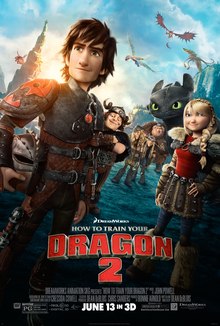
How to Train Your Dragon 2 (2014)


A brown haired boy, holding a helmet by his side, his friends and a black dragon behind him. Dragons are flying overhead.

Released:  June 13th, 2014
Rated:  PG
Studio:  Dreamworks Animation
Starring:  Jay Baruchel, Cate Blanchett, Gerard Butler, Craig Ferguson, America Ferrera, Jonah Hill, Christopher Mintz-Plasse, T.J. Miller, Kristen Wiig, Djimon Hounsou, Kit Harington
Directed by:  Dean DeBlois 
Written by:  Dean DeBlois
Personal Bias Alert:  mildly enjoyed the first HtTYD, not a big fan of 3D


9 of 10


            Let’s talk about risks.  Risks for the viewers.  Few things break my heart more than seeing a much loved story expanded upon and expanded upon until everything I loved about it was beaten out of it.  Watching the shell of what it used to be limp along fills me with a nostalgic gloom, and I often wish that I could pay money to let the poor thing die.  “How to Train Your Dragon” was a much loved film, and although I didn’t have a strong attachment to it like others did, I was apprehensive about the sequel on behalf of those who did.  Add in that it’s a DreamWorks Animation product, a studio with a shaky reputation for quality, and a rare solo writing/directing effort from Dean DeBlois, and the feeling dropped to downright trepidation.  I hoped for the best, but I knew that as soon as I felt the film going off the rails I would be the first to turn on it.

            The sequel picks up the story five years after the first film, with Hiccup (Jay Baruchel) traveling far and wide to expand his map, find new dragon species, and generally satiate his curiosity.  He ends up stumbling upon dragon catchers who inform him of a Viking named Drago (Djimon Hounsou), a man intent on building an army of dragons to take over the world.  The passive Hiccup opposes this idea, and while trying to find Drago he is captured by a mysterious dragon rider.  She turns out to be his long-lost mother, who seems to be the genetic source for Hiccup’s dragon talents.  With the family reunited, they work together to thwart Drago’s march and free his enslaved dragons.

            Too often, sequels feel like entirely separate chapters from the original.  The first movie is made with a contained story, and if it is financially successful enough to warrant a sequel, then the second film is put into production.  This leaves a bit of a chasm between the films, and it often feels like they exist separately from each other.  “How to Train Your Dragon 2” avoids that pitfall.  It really feels like an extension of the first, with the characters having grown as they would have in the five years between the stories, and the themes from the first film being picked up and expanded upon.  Yes, it’s darker and more mature than the first, but it would seem a bit silly if Hiccup wasn’t dealing with bigger problems now that he’s 20.  It might be too much for very young children, but most will have no problem with the story.

            Now I’m not a big fan of 3D.  I find it unnecessary in most films, considering that half the time you just end up watching people standing around talking IN 3D!  Here, though, is an excellent example of when 3D really adds something.  Flying, or any instance where the characters are moving in a 3-dimensional plane, is when the 3D actually makes everything seem more realistic.  Much of this movie is spent with the characters flying around on dragons, and those scenes looked amazing.  There’s one in particular where Hiccup and his mother (voiced wonderfully by Cate Blanchett) are showing off to each other, and the combination of the effects and animation really adds to the emotional liveliness of the scene.  The animation deserves its own praise, bringing a variety of characters and dragons to life and imbuing them with a great sense of personality.  Pay attention to the background of the talky scenes, because there’s some great jokes going on back there.

            My main problem with the first film was with how basic it felt.  The story and the themes had been done numerous times, and although it was told in a very pleasurable manner, it felt very familiar to me.  The second is still a well-trod story, but it’s more filled out and moves along at a much better pace.  Some of the side characters are still cardboard thin, particularly the bad guy, but at least they have the excuse of being family film archetypes.

            “How to Train Your Dragon 2” is a rare instance where the sequel is better than its predecessor.  I may be going out on a limb here, but I liken this series to the “Toy Story” franchise.  The second HtTYD is just as good as any of the “Toy Story” films, and both franchises have managed to attract an audience far outside their target demographic.  But more importantly, they are both series that are/were intent on growing and developing with its target audience, and that ingrains them into a generation’s soul.

            Other Notes:
Ø  Another scene where the animation impressed me was when Hiccup’s parents danced together.  The contrast between the massive father and the angular mother was really enchanting
Ø  Some of the side characters, particularly Hiccup’s friends, get annoying and far too jokey.  Although, the running gag about the girl’s arm fetish was hilarious.
Ø  They really got a better handle on Astrid.  In the first, she was a throwaway tough girl, but in this one she gets her own personality.
Ø  SPOILER:  I cringed a bit at the end when Drago invited Hiccup to try to get through to Toothless.  I wish they had come up with a better way for him to do it.