Showing posts with label Hugh Jackman. Show all posts

Sunday, October 11, 2015

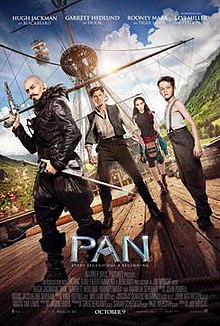
Pan


Pan 2015 poster.jpg

Released:  October 9th, 2015
Rated:  PG
Distributor:  Warner Bros.
Starring:  Levi Miller, Hugh Jackman, Garrett Hedlund, Rooney Mara, Amanda Seyfried
Directed by:  Joe Wright
Written by:  Jason Fuchs
Personal Bias Alert:  likes Joe Wright, not a big Peter Pan lover

5.7 of 10


            It’s been a mere 113 years since J. M. Barrie introduced the world to Peter Pan.  In that short amount of time, the impish boy has become ingrained in Western culture, carving out a place next to centuries-old fairy tales in the pantheon of childhood standards.  Today, the character is considered a personal favorite by many, a wondrous ode to childhoods we can never get back.  This love sets the bar high for any new version of the story, and anyone brave enough to meddle with the formula must either turn in a masterpiece or contend with the remonstrations of its ardent fans.

            Director Joe Wright and screenwriter Jason Fuchs are two souls brave enough to invent an origin story for Peter (Levi Miller), Captain Hook (Garrett Hedlund), and Tiger Lily (Rooney Mara) that shakes up their usual relationships.  Unfortunately, their gamble didn’t pay off well enough to be embraced by the masses, and the immediate backlash has made the off-kilter but enjoyable film out to be one of the biggest flops of 2015.  Hopefully its reputation softens over time, both because there’s a lot to appreciate here and because we should never discourage anyone from being bold enough to reinvent instead of just retelling the classics.

            Wright, who has made his fair share of good and bad movies, always turns in marvelous-looking films, and if for nothing else, this is why you should see Pan in theaters.  Few people pull back the camera quite like him, capturing big, meticulously staged sequences that are apt to take your breath away.  Shot for shot, few other filmmakers give us as consistently glorious visuals as he does, and the magical world of fairies and flying ships featured in Pan proves to be a ripe playground for his sweeping style.

            Wright is also well known for his scores, and while Pan features an appropriately swashbuckling one, it’s unlikely that anyone will walk out of the theaters remembering it.  Any commentary on the music in this film is sure to highlight the odd use of contemporary songs, most notably the jaw-droppingly weird sequence where we are introduced to Hugh Jackman’s Blackbeard by having thousands of men singing Nirvana’s “Smells Like Teen Spirit”.  Why?  This is never explained, although there is another similar scene a few minutes later.  Both take place early on in the film when everything that happens is so broad and utterly strange that none of it makes much sense.  These are some gratingly disjointed scenes, and if the rest of the film had continued to be that weirdly incongruous, we would be having an entirely different discussion.

            But eventually we are introduced to Tiger Lily, and the film is given a goal to steadily work towards.  The overt oddities subside, and we are left with a jaunty kids movie that has a delightful amount of weirdness.  The cast, who was previously hamstrung by Wright’s decision to go big and broad, settle into some actual relationships, and a calming force tamps the whole thing into submission.  Rooney Mara, inadvertently, I believe, is that force, as she was likely told to go big like everyone else but just didn’t have it in her.  She’s not a great physical actress, and while everyone else is prancing about, she walks through the film with the same shuffling gate as her version of Lisbeth Salander.  This isn’t to say that she doesn’t make her part work; if anything, Mara makes Tiger Lily into the most well-defined character in the whole shebang.   She just also brings the energy level down to a more palatable level.

            With such slapdash success, it’s wrong to label Pan as an outright failure.  It may not reach the heights that previous iterations of Peter’s story did, but there’s some wondrous moments to be found if you give it a chance.

Other Notes:
Ø  Some of the CGI here is atrocious, but I saw the same sort of doughy people in the opening of Avengers:  Age of Ultron.
Ø  I wasn’t as annoyed with Garrett Hedlund’s toothy performance as I thought I would be.
Ø  Maybe I’m just a sucker for Joe Wright’s style?

Sunday, March 8, 2015

Chappie


Chappie poster.jpg

Released:  March 6th, 2015
Rated:  R
Distributor:  Columbia Pictures
Starring:  Sharlto Copley, Dev Patel, Ninja, Yolandi Visser, Jose Pablo Cantillo, Sigourney Weaver, Hugh Jackman
Directed by:  Neill Blomkamp
Written by:  Neill Blomkamp, Terri Tatchell
Personal Bias Alert:  likes allegorical sci-fi, not seen anything by Blomkamp

4.9 of 10


            The frustrating thing about Chappie is how much it does right.  The positives aren’t hidden, and they’re easy to appreciate.  But they’re surrounded by flaws both big and small, so that even when you’re reveling in Chappie’s good choices, you have to push aside its distracting mistakes.

            This is the third feature film from writer/director Neill Blomkamp, all of which are the sort of heavily allegorical sci-fi pieces where you understand the allegory from just the plot summary.  Chappie is about the definition of consciousness and life, played out through the struggle of the world’s first sentient robot.  Nicknamed Chappie, he was one of the robotic police officers used in Johannesburg that had been damaged and scrapped, only to be stolen by developer Deon (Dev Patel) for a trial run of his A.I. side project.  Chappie is then stolen from Deon (that’s karma) by a group of thugs, who raise him as one of their own.

            This period, where Chappie is learning about the world, is where the movie shines.  Chappie looks astounding thanks to the work of animators at Image Engine and Weta Workshop as well as the performance by Sharlto Copley.  There was no motion capture involved, but Copley performed the part on set and lent his voice to the final cut, giving the animators detailed body movements and emotional cues to work from.  Chappie, along with last year’s Dawn of the Planet of the Apes, are the only films to feature CGI characters that actually look like they’re in the same frame as everything around them, and that feat still leaves me floored.  The design of the character is just as important to this feat as the animation, and again Chappie draws top marks.  Drawing heavily from previous robot creations like the droids from the Star Wars prequels, the designers added small touches like emotive, ear-like antennae that bring much needed depth of emotion to the robotic character.

             Thanks to Chappie’s beautiful rendering, it’s easy for the audience to form an emotional bond to the child-like robot.  Yes, he’s big and tough, but he’s also naïve and lost, struggling to find his way in this brave new world.  The amount of compassion this engenders might catch you off guard, especially in a scene where he’s abused by a rival developer played by Hugh Jackman.  Establishing this connection goes a long way towards making the rest of the film work, especially after the film trades in these emotional beats in favor of big, violent action.

            The distracting mistakes of Chappie mostly stems from its writing, which fails to deliver rounded characters, a plausible plot, and any sort of idea about the themes and allegories its playing with.  Pretty much everything but Chappie himself is a farce, as other characters are too extreme to be taken seriously and plot points are shoved in to move the story forward without any regard to reality.  Not helping things is the fact that two non-actors were cast in main roles, Ninja and Yolandi Visser of the band Die Antwoord, who seem to be playing their stage personas and lack the ability to convey complicated emotions.  However, it’s the horribly overdone performance by Hugh Jackman that stands out as the worst.  Granted, his character was the most poorly written, but I don’t know how anyone watched his flailing performance in the climactic battle and didn’t call for a reshoot.

            A story about the first artificially intelligent machine naturally brings up questions of consciousness and existence, and it’s astoundingly disappointing how much these are glossed over in Chappie.  Instead of any actually debate about the answers to these questions, the movie simply chooses one path to go down and never looks back, if it even stops to examine the question at all.  There’s a point where the plot stumbles right into the scenario posited in the Swampman thought experiment, but I’m going to assume that the writers had never heard of it considering that the question it raises is never even acknowledged.  I, however, had this and many other questions gnawing at the back of my brain the entire time, which made the plot really hard to swallow.

            And yet, as frustrating as all these faults are, Chappie comes very close to working.  Blomkamp knows how to film action sequences, and Chappie himself is so endearing that you remain emotionally invested even when the plot does spin out of control.  That you care so much about the robocop is a feat, but most everything else is just a mess.

Other Notes:
Ø  One character is subtitled.  I think it’s because he was speaking broken English with a thick accent (it’s possible it was a different language), but either way, it stuck out like a ridiculous sore thumb.
Ø  This is the kind of movie where the big, indestructible robot continuously gets distracted by guys with little guns that aren’t doing any damage to him.
Ø  It’s like they tried to make an intellectual film, but forgot to put in the intellect.

Sunday, May 25, 2014

X-Men: Days of Future Past (2014)


X-Men Days of Future Past poster.jpg

Released:  May 23rd, 2014
Rated:  PG-13
Studio:  Twentieth Century Fox
Starring:  Hugh Jackman, James McAvoy, Michael Fassbender, Jennifer Lawrence, Halle Berry, Anna Paquin, Ellen Page, Peter Dinklage, Ian McKellen, Patrick Stewart
Directed by:  Bryan Singer                 
Written by:  Simon Kinberg
Personal Bias Alert:  X-Men is my favorite franchise, haven’t read any of the comics, vaguely remembers watching the ‘90’s cartoon

8.5 of 10


            Hugh Jackman’s Wolverine has been the breakout star of the X-Men franchise from the beginning.  He was the conduit for the audience in the first film back in 2000 and served as the anchor for the rest of the trilogy.  He’s the only character to have an individual film (in fact, he has two), and of the seven films in the X-Men franchise, only “X-Men:  First Class” didn’t feature him in a starring role.  No surprise, then, that when the writers chose a time-bending storyline from the comics for the next film, they changed the time traveler from Kitty Pryde to Wolverine.

            There’s actually another good reason for making that change.  Wolverine is a survivor, a man who’s lived an inordinately long life, and because of that has endured more than the rest of them.  He sort of operates as the franchise’s observer; he experiences everything, takes on most of the pain, and lives with the memories.  It’s made him gruff and closed-off, and yet he’s managed to retain some measure of hope.  Given what he’s been through, that hope has weight, and it becomes imperative that he gets that across in “Days of Future Past.”

            At the opening, humanity has turned on the X-Men from the original trilogy and are hunting them down using robots called Sentinels.  Their only hope for survival is to send Wolverine’s consciousness back to the 1970s to stop Mystique (Jennifer Lawrence) from killing the Sentinel’s designer and inadvertently giving the humans the key to the Sentinel’s future success:  the ability to take on a mutant’s powers.

            Most of the film takes place in the flashback, with Wolverine teaming up with the cast from “First Class” to stop Mystique.  Wolverine finds everyone reeling from the events of “First Class,” none more so than Prof. Xavier (James McAvoy).  He’s boozy and petulant, despondent over the losses he’s endured.  Wolverine’s main job becomes coaxing Prof. X into becoming the man he knew and the man everyone needs.

            Casting has always been a strong suit for the X-Men franchise, particularly in “First Class.”  Here they get to pick the best of the best, with Jackman, McAvoy, Lawrence, Nicholas Hoult as Beast, and Michael Fassbender as Magneto forming the central dream team.  They play off each other with ease, and the script gives them the opportunity to do some electric one-on-one scenes.  Their backing cast, many of which are listed as stars, include Patrick Stewart, Ian McKellen, Ellen Page, Peter Dinklage, and Halle Berry, to name a few. 

            A great cast is always exciting, but a poor script can leave you burned.  Hearing about the plot, there were so many red flags that I went into “Days of Future Past” with my guard up.  Time travel?  Mixed-trilogies cast?  Terrible title?  I didn’t see how they could pull off this seemingly bloated concept while retaining the strong character beats that has made the X-Men franchise stand out.  It got off to a rocky start with a blink-and-you’ll-miss-it explanation of why Kitty had to send Wolverine back in time and the nonexistent explanation for why Kitty can do this, even though I thought her ability was to run through walls.  But once Wolverine wakes up in the ‘70s, the story settles into a nicely building arc that feels smoother than most blockbusters.  Once you buy into the central conceit, the plot holds together fairly well, and the character stuff is just as strong as it was in “X-Men” or “X2.”

            I’ve always had a sneaking suspicion with the X-Men franchise that it works so well for me due to distraction.  There’s so many characters with so many different abilities that there’s always something or someone interesting to focus on, and particularly the films with Bryan Singer at the helm are good at knowing when to jump from one thing to another.  With most blockbusters there are three or four main characters, generally all working together towards the same thing.  This makes the plot pretty linear, giving you time to note all the holes.  The X-Men films almost always involves a massive, scattered cast of characters doing all sorts of visually interesting things, so when I start to think “Hey, that didn’t make sense,” I can’t even get the thought through my head before they’ve moved on.  I’m not sure how Singer’s able to do that, but I’m sure some of the credit should also go to Editor John Ottman.

            Ottman also provided the music for the film, which is just one in a long list of smaller things that the film got right.  What I love about the music is how it changes as the characters embark on different tasks.  The jailbreak scene, featuring a great bit part by Evan Peters, has a classic heist score, while some of the large set pieces having a thundering score more reminiscent of “Inception.”  The ‘70s clothes and hair is fitting without being distracting, and the visual effects are stunning.  As always with the X-Men films, I have to give it props for mixing in some solid humor as well.

            The most surprising thing about this film is how little it did wrong.  It goes down easy and remarkably quickly.  It’s not until you leave the theater that you realize how hard it must have been to do so many things so well.

Other Notes (Ridiculous Mutant Version):
Ø  Why couldn’t the portal girl just have everyone huddle together and make a portal surrounding them so the Sentinels can’t touch them?
Ø  Why couldn’t portal girl just create a portal for them all to go through that would take them away from the Sentinels?  Just put Wolverine on a gurney and wheel him through.
Ø  Why did Magneto fling himself so haphazardly onto the train?  He normally moves at a nice controlled pace.

Other Notes (Normal Version):
Ø  I liked that there weren’t too many “Hey, it’s the ‘70s!” jokes
Ø  The scene where Prof. X enters Wolverine’s mind is great.  I love that McAvoy’s tear stain was visible in his close-up.
Ø  So in the new future, everyone’s alive.  Even if we didn’t go to war, shouldn’t someone have died of natural causes or a car crash or something?
Ø  I live in Indianapolis, IN, and with the Indy 500 going on this weekend, the movie theaters were remarkably quiet.  Hopefully, that doesn’t hurt this film’s box office.
Ø  I’ve already seen this film twice, once in 2D and once in 3D.  I preferred the 2D.  The darkened picture I got at the 3D showing made several facial expressions less clear, and I always feel like 3D blurs the fight sequences.