Showing posts with label John Krasinski. Show all posts

Sunday, May 31, 2015

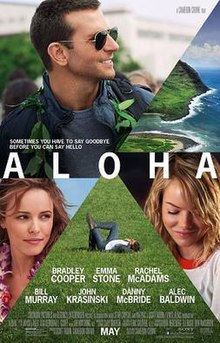
Aloha


Aloha poster.jpg

Released:  May 29th, 2015
Rated:  PG-13
Distributor:  Sony Pictures
Starring:  Bradley Cooper, Emma Stone, Rachel McAdams, Bill Murray, John Krasinski, Danny McBride, Alec Baldwin
Directed by:  Cameron Crowe
Written by:  Cameron Crowe
Personal Bias Alert:  huge Almost Famous fan, didn’t think Aloha could be as bad as people were saying

3 of 10


            There’s a certain fascination that overcomes you when watching this big of a train wreck.  It’s not so much a question of how it happened; movies are big, complicated beasts that can go wrong in more ways than you can count, but there is a sense of wonderment about how the film before you got released.  Someone, somewhere sat back after watching it, locked down the edit, and sent it out as a finished product to their bosses and to the world.  The shame and trepidation that must have enveloped them before hitting that send key had to be overwhelming, because no one can look at the final cut of Aloha and see a competent film.

            Competent, mind you, is a very low bar.  I’m talking about something that has a coherent plot and characters paired with an audio and visual presentation that isn’t off-putting.  That’s bare minimum of what a film should be, and Aloha manages to fail at three of these four things.  The first half is such chaos that it’s sort of stunning because you know the people in front of and behind the camera, can tell that they aren’t phoning it in, and it’s still a complete mess.  The film jumps around without any idea of where it’s going, the characters don’t have clear goals, the dialogue is, at times, nonsensical, the shot composition is occasionally ugly, and there’s jarring edits that interrupt any flow that the film manages to start.  The back half settles into something approaching coherence and gives you hints about what the film was supposed to be about, but irreparable damage has been done and you no longer care.

            What I think the film was supposed to be about is Brian Gilcrest’s (Bradley Cooper) struggle for morality.  As the opening narration explains, he once dreamed of going to space, but circumstances far from his control caused his aspirations to become mired in the dirty business of earning his spot.  After a failure and a long recovery, he returns to Hawaii for a chance to get his life back on some sort of track, and whether he chooses the right or wrong direction seems to be the film’s largest question.  Complicating matters is the love triangle between himself, a serious ex-girlfriend (Rachel McAdams), and his young, overly perky military liaison (Emma Stone).  Setting a story like this in Hawaii and steeping it in U.S. military and native Hawaiian culture is actually kind of genius as the relatively short battle between these two groups have gone down as one of the most corrupt and bullying engagements the U.S. has ever embarked upon (I recommend Sarah Vowell’s Unfamiliar Fishes for an entertaining history lesson).  If put together correctly, this could’ve been a rich film about a man and a country’s struggle to achieve noble aspirations in spite of their old, dishonorable habits.

            Unfortunately, Aloha doesn’t cobble this message together until late in the film, and even then it remains murky.  This is one of the films that got caught up in the Sony hacking incident late last year, with reports surfacing that the film was a mess and had to undergo extensive re-edits.  How bad it actually was to begin with isn’t currently known, but whatever edits they did make certainly didn’t improve it.  The final cut is so nonsensical that entire conversations have no meaning and have nothing to do with what happened in the scene before.  It’s as if they hired someone with brain damage, one of those unfortunate people who can’t remember things for more than 30 seconds, and paid them to edit the film.  Someone like that would probably like Aloha, because for all its shortcomings the cast is still likable and Hawaii is still beautiful.  On a moment to moment basis, the character’s arguments and motivations might make sense and the occasional horrendous shot could be quickly forgotten.  But most of us do have long-term memory, and Aloha is a film that will stay in there for all the wrong reasons.

Other Notes:
Ø  The opening credits roll over two entirely different setups.  One is a music montage over images of Hawaiian culture while the other is Bradley Cooper narrating his character’s background.  Neither go together and the transition between the two is abrupt.  It’s like they had two ideas for how to open the film and couldn’t decide which to go with, so they went halfsies in such a way that everyone lost instead of won.
Ø  The romance doesn’t work.  I have no clue if that’s due to the awful edit or a lack of chemistry.  Your guess is as good as mine.
Ø  I don’t think this film is guilty of whitewashing Hawaiian culture, but Emma Stone’s character is certainly whitewashed.  I still love Emma Stone, though.

Wednesday, March 4, 2015

Brief Interviews with Hideous Men


Brief interviews poster.jpg

Released:  January 19th, 2009
Rated:  Unrated
Distributor:  IFC Films
Starring:  Julianne Nicholson, Timothy Hutton, Max Minghella, Lou Taylor Pucci, Dominic Cooper
Directed by:  John Krasinski
Written by:  John Krasinski
Personal Bias Alert:  haven’t read any David Foster Wallace, likes batting around ideas

7 of 10


            Some movies have a certain rhythm that, when starting the film, makes you feel like you’re jumping on a slow-moving train.  You know that it will continue to chug along, never gaining too much speed nor grinding to a halt, giving you a comforting sense of consistency.  There’s an awareness that you can jump off whenever you want, and although nothing particularly riveting is happening, you stay along for the ride.  That’s what watching Brief Interviews with Hideous Men feels like; it’s brisk and pleasant, never overly impressing you, but never giving you a reason to turn away.

            As an adaptation, Brief Interviews comes with some particularly difficult obstacles to overcome.  First off, it’s based on a collection of short stories instead of a complete novel, so a through line following a female interviewer had to be created to give the stories some overarching structure.  Second, the stories were written by David Foster Wallace, an author known as much for the quality of his writing as the density of it.  Several studios have optioned Wallace’s work only to have the projects fall apart when the screenwriters get lost trying to distill the piece.  This is, in fact, the only adaptation to make it to audiences, brought to us by The Office star John Krasinski.  Considering he had never written nor directed before, he will undoubtedly seem like one of the last people capable of pulling the feat off.  His inexperience shows, but so does his enthusiasm and love for the material, and it’s this energy that carries you through the ups and downs of the piece.

            Krasinski does have a small role, but the lead belongs to the purposefully enigmatic Julianne Nicholson.  She plays the created character, the interviewer of the hideous men, gathering their monologues for some sort of psychological or philosophical research.  She says little, her face remaining placid throughout each interaction.  You come to realize that this isn’t a facade for her research but her natural state, and the reasons for her questions may be more personal than she lets on.  Nicholson does a remarkable job of giving the audience just enough to suss out her character’s thoughts, often using only a slight adjustment of her face to convey how many wheels are turning in her head.

            The cast of hideous men is filled with TV actors that presumably are friendly with Krasinski.  They breeze on and do their small roles, often having been matched to characters that fit comfortably in their wheelhouse.  Wallace’s words here are the real stars, conveying male embarrassment and the occasional challenging hypothesis with humor.  It does, at times, cross the line into grandiose self-importance, but for each slip there’s a new and delightful story nipping at its heels.  By the end, the men’s stories are sliding in and out of each other, forming into the interviewer’s hideously twisted perception of men until it ends with her quietly observing the culmination of her findings:  the most hideous man of all.

            For the most part, Brief Interviews is a bare-bones production, with basic (and cheap) sets, costumes, and music.  The one flourish is the camerawork, which initially seems out of place until you realize how much its working with the script to simulate the interworkings of the interviewer’s mind.  It’s small things at first, like seeing the men’s stories play out around them, through which we see how she imagines their roles in them.  By the end of the movie, reality becomes even more lost as she imagines them telling the same manipulative stories over and over again, or, in a riveting sequence, we see a series of intercut conversations that escalate in emotion and honesty, forming into a frenzy of ideas that she may or may not accept.

           
The whole enterprise is a tightrope to walk, one which Krasinski and company often fall off of, but what’s exciting is how they always jump right back on, too enthused to realize their failings.

Other Notes:
Ø  The last scene was overwritten.
Ø  I like the chorus section of the two college students talking about what modern women want.
Ø  “I don’t suppose you know where the little wrangler’s room is in this place, do you?”
Ø  That title, though.  That’s a great title.