Showing posts with label Alicia Vikander. Show all posts

Sunday, December 20, 2015

The Danish Girl


The Danish Girl (film) poster.jpg

Released:  November 27th, 2015
Rated:  R
Distributor:  Focus Features
Starring:  Eddie Redmayne, Alicia Vikander, Matthias Schoenaerts, Ben Whishaw, Amber Heard
Directed by:  Tom Hooper
Written by:  Lucinda Coxon
Personal Bias Alert:  loves Vikander, haven’t read the book

6.8 of 10


            Welcome to your stuffy British Oscar bait!  You’d be hard-pressed to make a film more tailored for awards season than The Danish Girl, which has the distributor, topical storyline, and pedigree to make its run blindfolded.  In a way, that appears to be what it’s doing, as after a rousing premiere at the Venice Film Festival it stumbled in Toronto and has been limping along ever since.  But it’s still got foolproof nominations for Eddie Redmayne and Alicia Vikander, who’s strategically running in the supporting category, and remains in consideration for several other categories.  That’s the power of perception for you, because taken on its own accord, The Danish Girl deserves little more than a polite nod as you leave the theater.

            That topical storyline has to do with the growing prominence of transgendered people in Western media.  The Danish Girl draws upon the story of one of the first people to ever get sex reassignment surgery, the artist Einar Wegener/Lili Elbe (Redmayne).  I say draws upon because this story plays very loose with the facts, an easy freedom that isn’t inherently negative, but unfortunately wasn’t used here to form a well-structured movie.

            The Danish Girl is adapted from the novel of the same name, which I’m assuming is where the focus on the relationship between Einar and has wife, Gerda Wegener (Vikander), comes from.  It’s an excellent plan to root the story in the universally relatable situation of loving someone who’s changing before your eyes, and the pairing of such emotive actors as Redmayne and Vikander really allows that story to take off.  They play off of each other so well, vivaciously bubbly when they’re in love and misty-eyed when in rough patches, that the complexities of their ever-changing relationship is remarkably easy to track.

            The problem is that screenwriter Lucinda Coxon doesn’t match this relationship’s emotional arc to the plot’s structure, allowing the turning point in the relationship to come far too early and for the same dynamics to drag along for long stretches of time.  The plot itself becomes very bogged down in the physical aspects of Einar/Lili’s transition, from the adoption of feminine movements to the surgeries themselves.  This is understandable considering that her physical transformation is what she’s remembered for, but this doesn’t bear much emotional heft on its own.  By not pairing the plot’s climax to the couple’s relationship, the back half of this film becomes remarkably dispassionate, and its ending feels like nothing more than a rote bid for tears.

            Director Tom Hooper has a certain self-aggrandizing tone that he uses as his de facto mode of storytelling, which has led to two straight Best Picture nominations and certainly produces austerely beautiful films.  The Danish Girl proves to be no exception, as everything from the score, sets, costumes, and cinematography is impeccably done.  His framing of shots have often resembled posed paintings, which fits nicely with the galleries and workshops much of this film takes place in.  Stills from this movie would look lovely framed and hanging on a wall, but this style matches poorly with the film’s uneven emotional resonance, so much so that when the couple’s relationship ebbs from time to time, the film becomes very flat.  Hooper does nothing to address the story’s shortcomings, apparently feeling that a nice presentation was all the screenplay needed, which indicates a massive failure to understand the story he was tasked with telling.

              Thank god for Redmayne and Vikander, who prove to be the only ones capable of injecting some life into these stiff proceedings.  It’s encouraging that, for all of The Danish Girl’s Oscar maneuverings, the two people who truly delivered at their jobs are the only ones assured of its golden recognition.

Other Notes:
Ø  Ben Whishaw and Matthias Schoenaerts give solid, if stiff, supporting turns.
Ø  Whishaw may be one of the few people to have appeared in more films than Vikander in 2015.
Ø  I adore the way this film shows people painting through the back side of the canvas.

Sunday, November 1, 2015

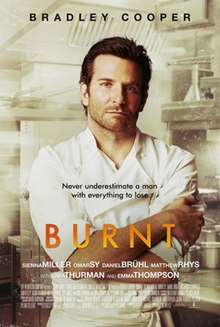
Burnt


Burnt Poster Updated.jpg

Released:  October 30th, 2015
Rated:  R
Distributor:  The Weinstein Company
Starring:  Bradley Cooper, Sienna Miller, Omar Sy, Daniel Brühl, Matthew Rhys, Alicia Vikander, Emma Thompson
Directed by:  John Wells
Written by:  Steven Knight
Personal Bias Alert:  likes Bradley Cooper, not a foodie

4.2 of 10


            Oh crap, a pun-ready title.  That encourages a hard stance, a snappy line that sums up the film in forty characters or less.  Too bad Burnt is messier than that, getting a bushel of things right and a peck of things wrong.  I’d be so easy to tell you all a funny yea or nay, but you’ll be better served by the honest breakdown that follows.  Still, the puns must go on, so here’s my effort:  The end result of Burnt is really more of a singe, luring you in with a solid couple only to give you a painful nip from the half-baked story.

            Still here?  Excellent, because it’s time to get to the good stuff:  Bradley Cooper, Sienna Miller, and all of the cast, really.  This is a film filled with people you’ll recognize but may not be able to place, and you’ll know them because they’re as solid a group of actors as you can get.  Obviously, everyone will know Cooper and Emma Thompson, and many will have gotten familiar with Alicia Vikander, but the rest are a hodgepodge of people who’ve been kicking around the international market for a decade plus.  They aren’t ones to phone in a performance, so even when this material falters, they’re able to pick it up and carry it to the finish line.

            And the material falters quite often, taking an overdone premise (asshole genius fighting his way back to the top) and adding an equally overdone twist by placing it in a small subset of society (high-end cooking).  If you dress up this outline correctly, people think it’s a modern masterpiece, but if you get it wrong, it becomes a groan-inducing bore.  Unfortunately, Burnt falls into the latter category, failing to make the world of chefs engaging or to make its antihero remotely likable.

            The film starts out on the wrong foot in the second category, showing Cooper’s Adam Jones shucking oysters until he hits the magical number of one million.  The instant he’s hit this, he takes a satisfied breath and walks out of the hole-in-the-wall restaurant he’s in, much to the consternation of his employers.  This is meant to play as a moment of redemption, a completion of penance for the wrongs he has done, but by walking away mid-shift, he proves that his time away hasn’t really changed him at all.  If this was simply a jumping-off point it would be a forgivable opening, but the character remains this way throughout most of the film, much to the annoyance of everyone around him, including the audience.  Cooper tries to play up his charm, but the character simply isn’t given any redeeming qualities except that he can allegedly cook well.  This, however, doesn’t engender any sympathy for the character because an understanding and love of cooking is never conveyed to the audience.  Director John Wells and cinematographer Adriano Goldman try to sell the cooking with some energetic montages of Cooper and company experimenting and working the service line, and while these scenes are visually stimulating, it doesn’t actually explain what the hell they’re doing.  The script tries to have the characters wax poetic about it with some clunker lines that are far too overwritten to be powerful, and in the end the cooking comes off as nothing more than a generic thing that all of the characters happen to be doing.  Given that this is a film about an obsessed antihero, the inability to empathize with his obsession is a massive hindrance.

            It’s actually the B-plot, a cliché-ridden romance between Cooper’s Adam and Miller’s Helene that works the best.  She’s a recruit to his new restaurant, and they allegedly bond over they’re passion and skill for cooking.  Again, the failure to explain the cooking hinders this romance on the page, but Cooper and Miller have enough chemistry to make it work on the screen.  Their scenes have an easiness to them that the rest of the film lacks, and for brief moments, you’re actually able to like both of them.  Unfortunately, this is the B-plot, and after a brief moment in the sun during the middle portion of the film, it fades behind the doldrums of kitchen life.

            You’re enjoyment of this movie will really come down to how much mileage you get out of a charming romance and how many clichés you can stomach.  If you’re driven insane by seeing the same movie plots over and over again, then Burnt will be rather unpalatable.  But if you go into it looking for an innocuous romance, then Cooper and Miller will take you on a satisfying little trip.

Other Notes:
Ø  If you want to feel something when you watch people eat, go watch I Am Love.
Ø  The costume design for this film was remarkably dull.  The guys rarely got out of their fitted leather jackets.
Ø  So are cooks really evaluated by a tire company?

Thursday, August 13, 2015

The Man from U.N.C.L.E.


The Man from U.N.C.L.E. poster.jpg

Released:  August 14th, 2015
Rated:  PG-13
Distributor:  Warner Bros.
Starring:  Henry Cavill, Armie Hammer, Alicia Vikander, Elizabeth Debicki, Jared Harris, Hugh Grant
Directed by:  Guy Ritchie
Written by:  Guy Ritchie, Lionel Wigram
Personal Bias Alert:  knows nothing about the TV series, wasn’t into Sherlock Holmes

7.3 of 10


            Warner Brothers has given us quite an interesting lineup this year.  It’s shockingly devoid of surefire hits, the largest grosser of the year being American Sniper, which started its theatrical run in 2014.  San Andreas, the out-of-fashion disaster flick comes in second, with the reboot Mad Max:  Fury Road taking third.  To cap the summer season, the studio gives us one of its more bizarre investments, a reboot of the 50-year-old television show The Man from U.N.C.L.E.  Sure, it’s a spy film (which is very in this year), but the movie’s younger target audience is mostly unaware of the television series, and the film allegedly has moved far enough from its source material to turn off preexisting fans.  This certainly won’t be a huge hit for the studio, but the film’s good-time jauntiness should have the legs to carry it well past its $75 million price tag.

            Guy Ritchie, who previously turned Sherlock Holmes into a hit, helms this origin story, exploring how the multinational spy unit of the television series formed.  He keeps the ‘60s setting, which proves to be an excellent fit for his brand of funny, stylish action.  Everyone from the costume and set designers to the actors seems to have enjoyed basking in the slightly garish looks, which serve as an inescapable bit of flair that reminds you how unreal all this is.  And none of it is intended to be taken very seriously, as even the action is tuned low enough to let the whole thing slide down smooth.  After all this summer’s dour CGI punching, it’s a wonderful change of pace to watch a movie that just wants you to have some fun.

            Key to this fun is Henry Cavill, who stars as American agent Napoleon Solo.  He’s all slicked hair and cocky humor, making for a delightfully lively performance from our current Superman.  The character was written for someone to take a big bite out of, and while Cavill may not have been the most obvious choice, he turned out to be the perfect one.  Armie Hammer plays his Russian counterpart, who serves as more of a hulking straight man to Cavill’s overwhelming swagger, but he works the part well enough.  An always welcome Alicia Vikander rounds out the group as the young woman they’re using to flush out a nuclear bomb.  She’s often reduced to prancing around in vintage garb (there’s an entire scene about her wardrobe, in fact), but she gets to poke the boys often enough to stay relevant.  The rest of the cast hits their marks in what are essentially bit parts, chewing on the scenery when needed and exiting with dignity when our main trio asserts themselves.  What the film comes down to is Cavill, though, and he knocks this thing straight out of the park.

            Providing audiences with a throwback good time was obviously Ritchie’s main concern, as he left the plot remarkably light.  The airiness works, though, because it serves the tone so perfectly.  This was never intended to be Skyfall, but the setup provides enough opportunities for some well-designed action scenes.  Some are sillier than others, to the point that one is outright dismissed by one of the characters in the scene, and this de-emphasis may disappoint those accustomed to having the action be the focal point of their spy movies.  The humor is the true star here, and even if it gets in the way of an unsurprising plot, it’s delivered so perfectly that the film’s extraneous downfalls are easy to forgive.

            Such an easily enjoyable film should serve as excellent counter programing to this week’s other big release, Straight Outta Compton.  This material was never going to be an easy sell, but its good looks and scallywag appeal should help it find the laid-back audience it seems to be looking for.

Other Notes:
Ø  This would have been better if it was about 10-15 minutes shorter.
Ø  So you know Oscar Isaac’s weirdly awesome dance scene in Ex Machina?  Well, Alicia Vikander gets her own this time.
Ø  The end of the café scene is brilliant.
Ø  For some reason I thought Armie Hammer was British.

Saturday, May 2, 2015

Quick Hits

I saw several movies this past week and thought I’d given you a quick rundown on what I thought of them.  Enjoy!

Child 44

Child 44 poster.jpgReleased:  April 17th, 2015
Rated:  R
Distributor:  Summit Entertainment
Starring:  Tom Hardy, Gary Oldman, Noomi Rapace, Joel Kinnaman, Jason Clarke, Vincent Cassel
Directed by:  Daniel Espinosa
Written by:  Richard Price
Personal Bias Alert:  likes all of the cast, was turned off by the thick accents in the trailer

3 of 10


            There’s an obvious place to start with Child 44, and that’s the plot.  I’m guessing that the novel it’s based on (which I haven’t read) is a twisty, layered piece that takes a broad look at the problems plaguing Soviet Russia through the eyes of MGB Agent Leo Demidov.  A movie doesn’t have the time to examine all of this and still pull off the crime investigation at its center, and screenwriter Richard Price seemed to get lost in the quagmire of the large plot.  Child 44 never attains a clear point, jerking wildly from event to event instead of weaving them into a streamlined tale.  Director Daniel Espinosa also shows off his shortcomings in a series of poor choices that produced a film with a dull color palate, in-your-face accents, and an inability to grasp its main character.  The actors stumble with this poor material, especially Noomi Rapace, who is sidelined for most of the film, and Joel Kinnaman, whose accent comes and goes within sentences.  Avoid this one, which shouldn’t be difficult as it’s already dropping from theaters.
_______________________________________


Ex Machina

Released:  April 10th, 2015
Rated:  R
Distributor:  A24
Starring:  Domhnall Gleeson, Alicia Vikander, Sonoya Mizuno, Oscar Isaac
Directed by:  Alex Garland
Written by:  Alex Garland
Personal Bias Alert:  has a budding love of A24, likes smart sci-fi

7.8 of 10


            The most buzzed about film right now that doesn’t rhyme with lavenger is undoubtably this slice of classic sci-fi.  The story of man achieving A.I. opens a big can of existential worms, and while Ex Machina treads over questions we’ve seen posed before, it’s slick story and stellar style makes up for the lack of originality. 

Alicia Vikander plays the beautiful robot, or at least the face and hands, with the rest of her body appearing as a translucent mass of human-like machinery that’s censored in just enough places.  The care that the filmmakers put into her design can be seen in every aspect of this film’s visuals, from the carefully selected costumes, intricate set designs, and immaculate lighting.  Everything feels like it could exist now or a few years in the future given the limitless amount of money Oscar Isaac’s character has and that it’s all exactly what would make each character tick.  Vikander and Isaac are excellent in their roles despite the fact that the foreshadowing they’re forced to play reveals too much about what’s to come.  Domhnall Gleeson has a sort of thankless, straight-man role which he’s suited for but doesn’t push to anything great.  As in much of sci-fi, their characters are secondary to the plot, and while their performances and the lean way in which the story unfolds is appealing on the surface, there’s a constant sense of how little lies beneath.  This is a wonderfully appealing film, but it lacks the staying power of truly smart sci-fi.


                                      _______________________________________


Clouds of Sils Maria

Image result for clouds of sils maria posterReleased:  April 10th, 2015
Rated:  R
Distributor:  Sundance Selects
Starring:  Juliette Binoche, Kristen Stewart, Chloë Grace Moretz, Lars Eidinger
Directed by:  Olivier Assayas
Written by:  Olivier Assayas
Personal Bias Alert:  salivated over it for almost a year after missing it at TIFF, doesn’t hate on K-Stew

8.4 of 10


            Movies don’t get much more meta than this.  For the sake of time, I’ll leave it to you to look up the many ways the story overlaps with the lives of those making it, but I recommend you look up the actor’s and director’s backgrounds before you see this film.  It adds a level to this already multi-layered film that I believe you’re expected to get, although your head will likely be spinning even without this extra nuance.  Clouds of Sils Maria is ostensibly about an actress returning to the play that jump-started her career but in the role of the older woman.  It quickly turns into a much larger meditation on aging and the difference between how you interpret the passage of time in your life versus how others see it, with a heavy sprinkling of commentary on ageism in an industry that has clear-cut expectations for women both young and old.  In other words, it’s thick stuff that leaves you wanting to see it again, if only to unravel the loose ends that it leaves flitting in your mind.

            The cast, led by the always impeccable Binoche, navigates the mired plot with a surprisingly firm grasp of character.  Certainly this reflects the thorough work of writer/director Olivier Assayas, but the trio of actresses are the ones who latch on to every aspect of these complex and personified characters, remarkably getting across the larger ideas without a hint of the writerly artifice that Binoche’s character at one point denounces.  Stewart, as you may have heard, is the most surprising here.  It’s the scenes between her and Binoche, isolated in a cabin and feverishly prepping for the play, that crackle with fraught meaning, and it’s here that the audience and the characters rub up against the open wounds that the film is exploring.


            As with many pieces this ambitious, there are moments when its reach stretches farther than its grasp, and Assayas isn’t always as artful about his visuals as he is about his words.  On a technical point, there’s annoyingly poor continuity here, with glasses and cigarettes constantly shifting around the frame, but these are nothing more than momentary quibbles in a dizzyingly smart film.