Showing posts with label Ewan McGregor. Show all posts

Wednesday, July 1, 2015

Perfect Sense


Released:  February 3rd, 2012
Rated:  R
Distributor:  IFC Films
Starring:  Ewan McGregor, Eva Green, Ewen Bremner, Stephen Dillane, Connie Nielsen
Directed by:  David Mackenzie
Written by:  Kim Fupz Aakeson
Personal Bias Alert:  loves Eva Green, not big on romance

7.7 of 10


            Movies, while quite evocative, only work with two of your senses:  sight and sound.  There have been attempts to add touch and smell, but both have proven too costly a gimmick.  The limitations of this setup are rarely apparent, but they’re hard to miss in Perfect Sense, which depicts a world where humanity is losing their senses one by one.  The horror of such a strange loss has been seen before (watch/read Blindness), but it’s rarely as visceral as it is in Perfect Sense, which goes far out of its way to make the audience feel each blow.  When director David Mackenzie succeeds at this, the film floors you with its emotional ramifications, but just as many times the loss isn’t palpable enough to support the film’s misty-eyed philosophizing.

            Instead of focusing on society’s slow disintegration or using the situation as a metaphor for some larger cultural examination, writer Kim Fupz Aakeson chose to take the high concept and apply it to a simple parable about the power of love and connection.  To those of you gagging, please bear with me, because I normally hate that kind of mush, too.  The wonderful Ewan McGregor and Eva Green are your main couple, who fall in love as the disaster unfolds.  While their relationship isn’t that well-written and both characters feel more like a collection of affects than real people, McGregor and Green are such emotive actors that you get behind their relationship despite the false notes.  But it’s not just their love lives that prove meaningful.  Both characters are quite invested in their jobs, he’s a chef and she’s an epidemiologist, and the strong bonds they have with their coworkers prove nearly as fruitful.  The first half of the film suffers because of the underdeveloped characterization, but over time Green, McGregor, and the excellent supporting players sell the relationships with such wholeheartedness that the film’s back half transcends sappiness and achieves that remarkably elusive white whale:  a moment of vicarious joy.

            Working in tandem with the cast to achieve this moment is a myriad of bold technical choices by Mackenzie that butters you up for the eventual climax.  Characters are brought to the extreme foreground of shots, and the camera jostles and sways as their emotions brim.  When their emotions are released, which occurs before the onset of each new stage of the disease, Mackenzie chooses to stay with them, letting the big, occasionally nasty scenes play out in graphic detail.  It’s all very off-putting at first, like the overdone efforts of an uncertain guide, but these spaced-out punctuations eventually wear down your defenses, forcing you to become comfortable around the character’s beating hearts.

            Nothing, though, is as essential to the film’s success as its score.  This is a film about loss, about whittling down the world to the bare essentials, and what these essentials end up being aren’t tangible things.  To access these abstract aspects of life, Mackenzie smartly leans on the music, which becomes more and more important as the film goes on.  Composer Max Richter leads us gently, allowing pieces to expand and grow along with their accompanying scenes.  For all of Mackenzie’s aggressive insertions, the score cannot be counted among them, and it proves to be the most emotionally evocative aspect of the movie.

            This is a bleeding heart film, one that, depending on your affinity for such rawness, will either move you to tears or make you run screaming from the room.  As with many open wounds, it’s quite ragged around the edges, but there’s catharsis and comfort to be had at the end of it all.

Other Notes:
Ø  I found it very interesting to watch the world crumble and pick itself back up over and over again.
Ø  I wish they didn’t have the narrator spell out everything.
Ø  Green’s continued use of the word ‘sailor’ felt incredibly false.
Ø  Wanna throw some rocks?

Wednesday, January 7, 2015

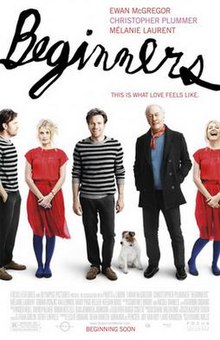
Beginners


Beginners Poster.jpg

Released:  June 3rd, 2011
Rated:  R
Studio:  Focus Features
Starring:  Ewan McGregor, Christopher Plummer, Mélanie Laurent, Goran Visnjic
Directed by:  Mike Mills
Written by:  Mike Mills
Personal Bias Alert:  both of my parents are alive, I’m a sucker for dogs

9.5 of 10


            I called my mom into the room when the Best Supporting Actor category came up at the 2012 Oscars.  She’s loved Christopher Plummer since she was a little girl and first laid eyes on him in The Sound of Music.  I knew that Plummer was about to win the Oscar, he was a shoe-in, and it was a pleasure to see her face light up as he took the stage.  She had never heard of Beginners, and I, having not seen the film, explained to her that he won for playing a gay man who came out after his wife died.  I wish now that I had seen the movie, because then I could’ve explained to her how much more his performance was than this simple little blurb and perhaps added to the moment.  Then again, this lament-tinged memory of my mother is a fitting accompaniment to a film filled with remembrances of misunderstood but loving parents.

            Plummer really does give quite a performance.  Vivacious, intelligent, and strong even in his dying days, Plummer’s Hal embraces this last chance to live another life and in doing so provides a meaningful last impression on his son.  You see, the film actually takes place a few months after Hal has passed on.  His presence in the film takes place entirely in the memories of his son, Oliver (Ewan McGregor), who seems stuck on trying to work out how his father’s revelation affected his parent’s marriage and his own handling of relationships.

            Writer/director Mike Mills, who based the story on his own father’s late coming out, seems to be trying to capture the very thoughts that run through a person’s head in a situation like this.  There’s an overarching fascination, in this case with the parent’s tepid and unimpassioned relationship, which gives rise to specific memories when reminders of little moments pop up in everyday life.  The memories are played out as real scenes, mostly between Oliver and his mother when he was just a boy and between Oliver and his father in the last months of Hal’s life.  The fascination is portrayed by non-narrative intercuts of the project Oliver is working on called The History of Sadness and some historical context for the time periods the movie covers.  This structure gives the film a decidedly quirky feel, but more importantly it tenderly captures Oliver’s emotions as he deals with the absence of his parents.

            In current time, Oliver is starting a relationship with an actress named Anna (Mélanie Laurent).  Both admit to not being very good at long-term relationships, which seems to only draw them closer.  Laurent is subtly complex in the way humans naturally are, and the chemistry between her and McGregor works.  A lot of the film’s weight falls on this relationship, and that added importance only made me root for them more.

            The other great performance and masterful piece of storytelling by Mills is the Jack Russell Terrier named Arthur that Oliver inherits from his father.  Played by a dog named Cosmo, he is Oliver’s constant companion and becomes rather anthropomorphic in his personification of Oliver’s mental state.  This touch is perhaps what made the film for me, because I have a mental block that protects me from getting too upset about a human character but leaves me unguarded against a dog.  Here, there’s a scene with Cosmo that had me welling up, and while it didn’t quite lead to a full cry, it’s still a remarkably rare achievement for a film.

            This is a quirky film, one that seems markedly longer than its 104 minute runtime, but it’s such a deliciously melancholic stew of love and loss that you’ll stay engrossed by it throughout.

            Other Notes:
Ø  The first film I loved in 2015.
Ø  The adopted owners of Cosmo also trained the Jack Russell from Fraiser.
Ø  I never figured out who Anna was supposed to be at the Halloween party.  I had to look it up and found out she was Julius Rosenberg.  Then I had to look up who Julius Rosenberg was.

Wednesday, July 23, 2014

Trainspotting

Trainspotting ver2.jpg

Released:  July 19th, 1996
Rated:  R
Studio:  Miramax
Staring:  Ewan McGregor, Ewen Bremner, Jonny Lee Miller, Kevin McKidd, Robert Carlyle, Kelly Macdonald
Directed by:  Danny Boyle
Written by:  John Hodge
Personal Bias Alert:  has a dark sense of humor, doesn’t do drugs

9 of 10

           Ain’t Danny Boyle great?  He’s got such flair, such style.  His films are peppy; they bounce off the walls, threatening to burst out of the screen.  He notably hopped for joy on the Oscar stage, explaining that he had promised his children to receive the moment in the spirit of Tiger from Winnie the Pooh if he was so lucky to win.  Although, he’s never apologized for his spirit.  He palpably loves filmmaking, and that energy makes me predisposed to liking his films because, hey, I love films, too.

            “Trainspotting” is one of his more effervescent directorial efforts, bounding along through its character’s lives even when there’s dark turns.  It’s easy to forget, especially early on in the film, how crappy these people’s lives really are.  They’re all heroin addicts, bumbling from hit to hit, constantly broke, willing to degrade themselves to maintain their habit.  But Boyle keeps us slightly removed from the proceedings, and the camera observes them with an arched brow, like the friend who hangs around because he finds your antics amusing.

            The main group is a volatile hoot, each so lost to their own individual faults that you know they can’t exist together for long without blowing something up.  Most often it’s their own lives that go down, and in the lesser falls Boyle and editor Masahiro Hirakubo find their comedy stride.  For instance, I was laughing aloud when main character Renton (Ewan McGregor) was listing off the things you need to quite heroin and ends matter-of-factly with “one last hit.”  We all know that attitude is a recipe for failure, and the editing and accompanying music cues invite us to laugh at Renton’s dreary situation.

            There is a turn, about thirty minutes in, when their situation stops being funny.  It’s a perfectly timed transition, having allowed us the space to connect and sympathize with the characters before the rug is pulled out from under us.  While the comedy largely gets left behind, the movie continues to amble on at its lively pace, which dulls the blows it continuously hits us with.  The events in this film are just as disturbing and hopeless as anything seen in other drug horror stories like “Requiem for a Dream” or “A Scanner Darkly,” but Boyle wisely avoids making things too dour.  We all know the destructive power of addiction, and perhaps this sort of presentation gives us a better idea of why people cling to it so fervently.  But what do I know, I’ve never been an addict.

             As I’ve mentioned before, the camerawork has a strong influence on how the audience views the proceedings.  It responds to the mood of the scene, drawing the audience along for the ride.  It jostles when a character’s excited, observes the absurd humor of a situation, and wraps you up in a rug to carry you through a high (that literally happens).  Boyle is known for his creative camerawork, and here it is integral to maintaining the film’s pace.  Through the darkest moments it tugs you right along, never allowing you to dwell on any one disaster.

            “Trainspotting” is a fast-paced little film, jamming in an absurd amount of story in 93 minutes.  The plot points aren’t always as fleshed out as they could be, but it’s an acceptable sacrifice in light of the tone the film is able to hit.  It won’t leave you smiling, but it’s one of the more enjoyable ways to spend time with self-absorbed drug addicts.

            Other Notes:
Ø  Oh Miramax, I miss you what you used to be.
Ø  Those shots of McGregor falling and hitting his head make me cringe.  How did they film those without hurting him?
Ø  “What a penetrating goal that was.”  He he, context.
Ø  Did I miss the train?